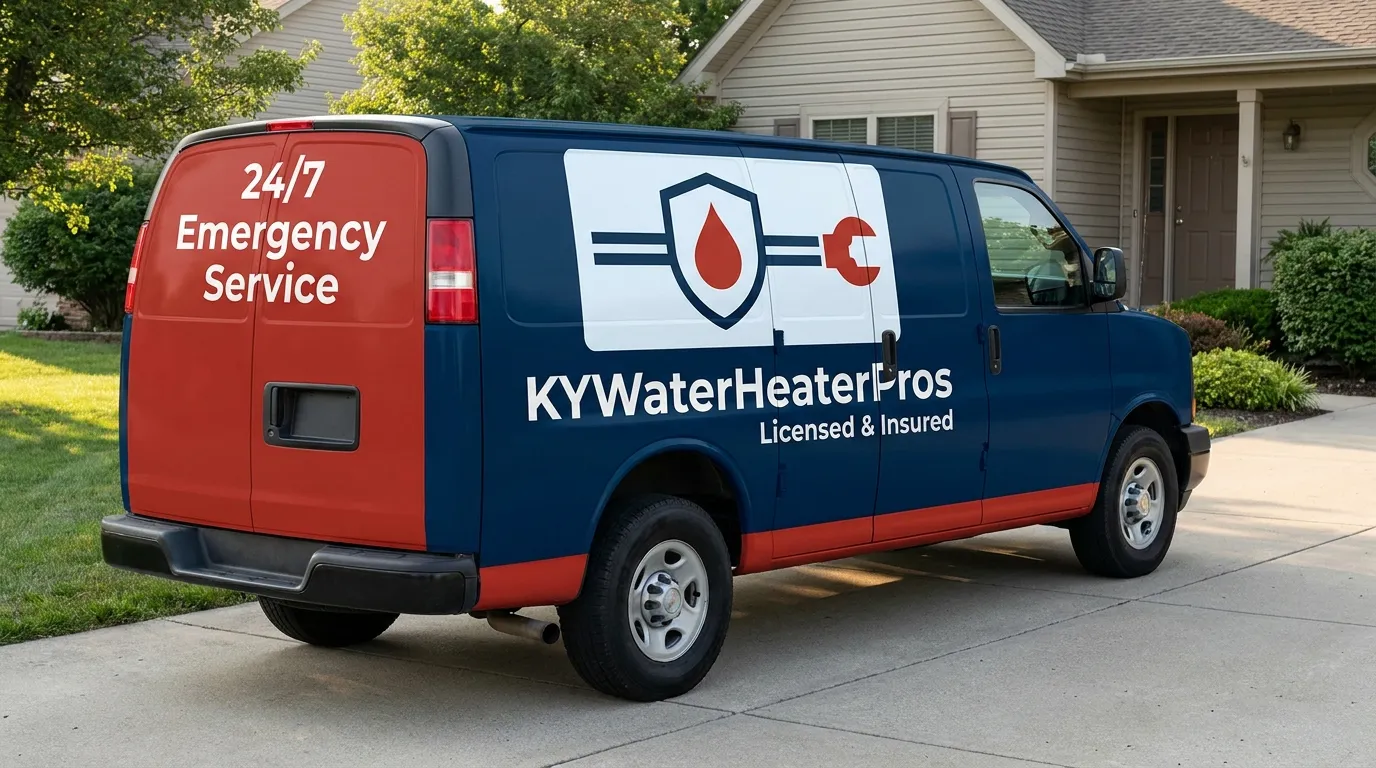
Water Heater Repair & Installation in Louisville, KY
Licensed Master Plumber contractors serving Jefferson County. Emergency water heater repair, replacement, and installation available 24/7.
Emergency Guidance
Gas odor near your water heater?
Evacuate immediately. Call 911 + gas company.
Active flooding from water heater?
Shut off water. Call +1-888-387-1216 for emergency routing.
24/7 Emergency
Always available when you need us
Licensed & Insured
KY Master Plumber contractors
Satisfaction Guaranteed
5-star rated service quality
Serving Louisville
Jefferson County & surroundings
Louisville's hard water—sourced from limestone aquifers and the Ohio River at 8-10 grains per gallon—attacks water heaters faster than softer water supplies found elsewhere. Minerals settle as sediment that insulates water from the burner, forcing the system to work harder and shortening tank life to 8-10 years instead of the typical 12. Anode rods, the sacrificial component protecting the tank from corrosion, deplete every 2-3 years here versus 5-6 years in softer water areas. That sediment also causes the rumbling and popping noises Louisville homeowners hear when their water heater cycles on.
Homes built between 1950-1970 in neighborhoods like Highlands, Crescent Hill, St. Matthews, Old Louisville, and Cherokee Triangle face a second challenge: galvanized steel pipes and cast iron drain systems that corrode from the inside. When a water heater fails in these homes, replacement isn't always straightforward. Corroded galvanized pipes restrict water pressure and introduce rust. Electrical panels in pre-1970 construction often lack the capacity for tankless upgrades without costly panel replacements running $1,500-$3,000. Venting systems frequently don't meet current code, requiring modifications during replacement.
We serve all 30 Louisville ZIP codes across Jefferson County—from downtown 40202 to East End 40245, from Jeffersontown 40299 to Shively 40216. Our Kentucky Master Plumber-licensed contractors understand the local conditions that make water heater service different here: the hard water chemistry, the aging housing stock, the permit requirements, and the code compliance work that older homes trigger. When your water heater shows signs of failure, you need someone who knows Louisville's infrastructure challenges and can navigate them efficiently.
Need Help Now?
Talk to a licensed plumber in Louisville
call+1-888-387-1216Free diagnostic quotes • No obligation
location_onZIP Codes Served
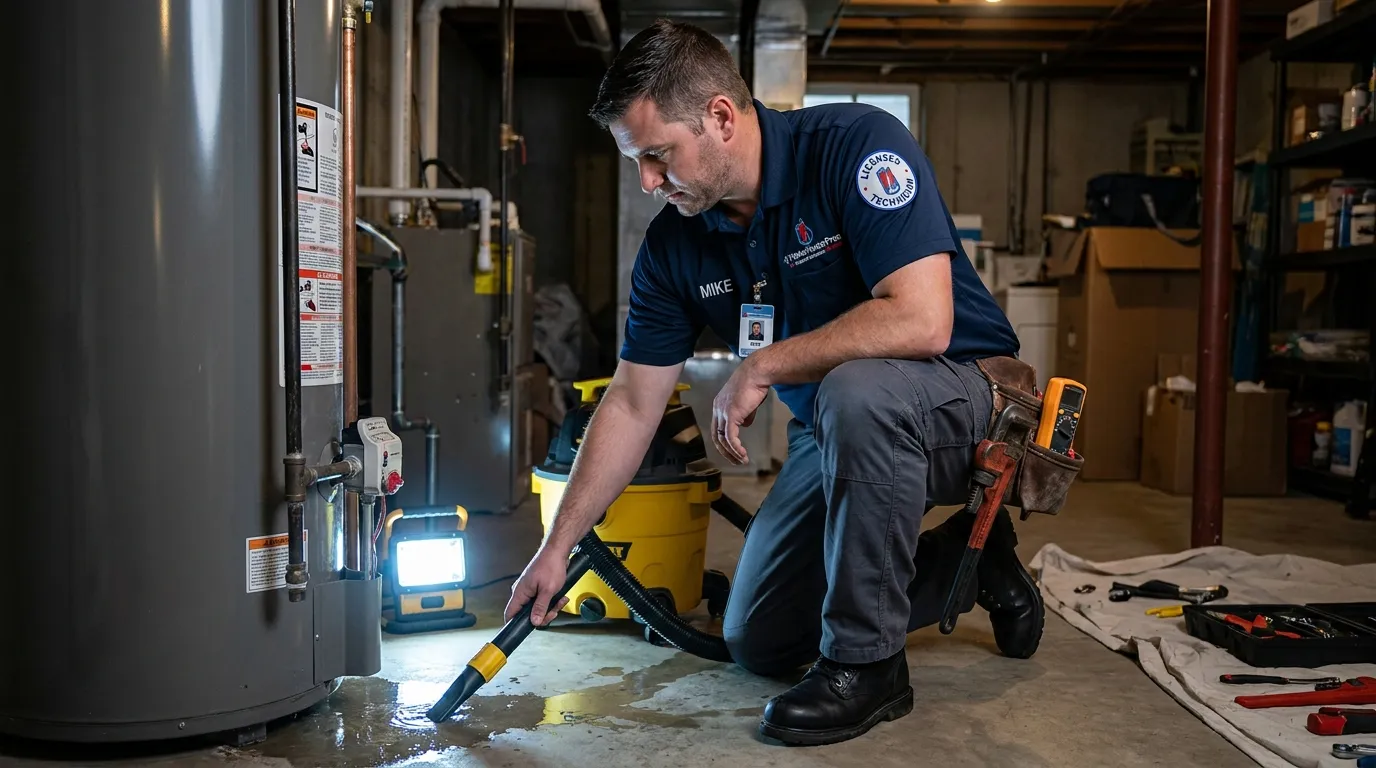
Is Your Louisville Water Heater Problem an Emergency?
If you smell gas near your water heater, see water actively spreading across your floor, or hear a carbon monoxide alarm, evacuate immediately and call 911—then call us at +1-888-387-1216 for the repair once emergency services clear your home. These situations require immediate action, not troubleshooting.
Most water heater problems fall into three urgency tiers. Understanding which category your situation fits determines whether you need emergency service right now, same-day scheduling, or can plan for the next few days.
Immediate Emergency (Evacuate and Call)
Gas odor near water heater: Natural gas and propane are both heavier than air and collect near the floor. If you smell the distinctive rotten-egg additive near your water heater, do not look for the source, do not flip light switches, do not use your phone inside the house. Get everyone out, leave the door open as you exit, and call 911 from outside. Then call your gas company's emergency line. Once they've cleared the safety issue, call +1-888-387-1216 and we'll repair or replace the water heater.
Active flooding: If water is spreading across your basement or utility room floor—not just pooling under the unit—shut off the water supply immediately. For tank water heaters, turn the valve on the cold water pipe entering the top of the tank clockwise until it stops. If that valve won't turn or you can't reach it safely, shut off your home's main water supply. Louisville homes built before 1980 often have the main shutoff near the water meter in the basement; newer construction typically places it in a utility room or garage. Call +1-888-387-1216 for emergency response. We serve all 30 Louisville ZIP codes with response times averaging 30-45 minutes to central neighborhoods like Highlands and St. Matthews, 45-60 minutes to outer areas.
Carbon monoxide alarm activation: CO detectors respond to incomplete combustion from gas water heaters with blocked vents or failing burner assemblies. Evacuate, call 911, and do not re-enter until emergency services clear the home. Water heater venting problems are common in Louisville's aging housing stock—pre-1970 homes in Crescent Hill and Old Louisville often have single-wall vent connectors no longer code-compliant, and shared venting with furnaces creates backdraft risk.
Urgent (Same-Day Service Required)
No hot water with faint gas smell: The pilot light is likely out. If you're comfortable relighting it and know your model's procedure, try once. If the pilot won't stay lit after following the lighting sequence, or if you're unsure, call +1-888-387-1216 for same-day service. A pilot that won't stay lit typically means a failed thermocouple ($150-180 repair) or gas valve issue ($300-400).
Leaking from top fittings or pressure relief valve: Water dripping from connections at the top of the tank often means loose fittings—repairable. Pressure relief valve discharge (the pipe on the tank's side or top) dripping constantly suggests either excessive pressure or a failing valve ($150-200 replacement). Both need same-day attention before small leaks become large ones. Turn off the water supply to the heater and call us.
Loud popping, rumbling, or banging sounds: Louisville's hard water (8-10 grains per gallon from limestone aquifers) causes sediment to accumulate 40% faster than the national average. That sediment layer insulates water from the burner, creating steam bubbles that collapse loudly. Left untreated, the sediment hardens into a concrete-like layer that overworks the heating system and cracks the tank. Schedule a flush within 24 hours. If the noise is sudden and metallic, call immediately—it could indicate imminent tank failure.
Hot water runs out much faster than normal: Sediment displaces water volume in the tank, or a heating element has failed (electric water heaters). A 50-gallon tank with 6 inches of sediment provides only 35-40 gallons of usable hot water. Homes in areas served by Louisville Water Company's limestone-heavy supply see this happen faster. Not an emergency, but quality of life degrades quickly. Same-day diagnosis recommended.
Scheduled (Plan for Next 1-3 Days)
Discolored or rusty water from hot taps only: The anode rod—a magnesium or aluminum rod that sacrifices itself to prevent tank corrosion—has likely depleted. In Louisville's hard water, anode rods fail every 2-3 years instead of the typical 5-6. If the water heater is under 8 years old and the tank isn't leaking, anode rod replacement ($200-250) can extend the unit's life 3-5 years. If the unit is 10+ years old, the tank itself may be corroding. Schedule an inspection within a week.
Water heater is 10+ years old with no current problems: Louisville water heaters fail at 8-10 years on average due to accelerated mineral buildup and anode rod depletion. Preventive replacement before catastrophic failure prevents the 40-50 gallon flood that ruins basement belongings and requires restoration services. If your unit is approaching 10 years and you haven't maintained it annually, schedule a replacement consultation. Peak failure times are January-February when incoming water temperatures drop to 38-42°F and systems work hardest.
Pilot light keeps going out (once every few weeks): Likely a thermocouple gradually failing, or draft issues from venting problems. Not urgent if you can relight it safely and it stays lit for days or weeks. Schedule a service call within 3-5 days to replace the thermocouple before it fails completely during a cold snap.
Louisville Response Time Context
Emergency calls to +1-888-387-1216 receive priority dispatch. Our average response times: 30-45 minutes to central Louisville neighborhoods (Highlands, Crescent Hill, St. Matthews, Cherokee Triangle, Butchertown, Germantown, Old Louisville), 45-60 minutes to outer areas (Jeffersontown, Middletown, Okolona, Shively, Pleasure Ridge Park, Valley Station). During I-65 bridge closures (June-July annually for maintenance) and peak traffic hours (7:00-8:45 AM, 4:30-6:30 PM), add 15-20 minutes. We route around construction via I-264 to maintain response times across all 30 Louisville ZIP codes.
After-hours emergency service (nights, weekends, holidays) adds a $150-200 premium to standard repair costs, but when you're facing active flooding or a safety issue, immediate response prevents thousands in water damage and protects your family.
Interactive Tool: Check Your Symptoms
Select your symptom below for immediate guidance and the right next step.
What problem are you experiencing?
Emergency water heater repair in Louisville, Jefferson County is available around the clock. If your water heater is leaking, producing no hot water, or making unusual noises, ourKentucky Master Plumber-licensed contractors can be at your door within 30 minutes. Call +1-888-387-1216 now for immediate dispatch to your Louisville address.
Common Water Heater Problems in Louisville Homes
From failing heating elements tripping breakers to corroded anode rods causing rusty water, Louisville's 8-10 grain hard water plays a direct role in these common failures. The limestone aquifer and Ohio River sources deposit calcium carbonate that precipitates when heated, coating internal components and accelerating wear. Understanding how Louisville's water chemistry attacks your water heater helps you catch problems early—before a 40-gallon tank ruptures and floods your basement.
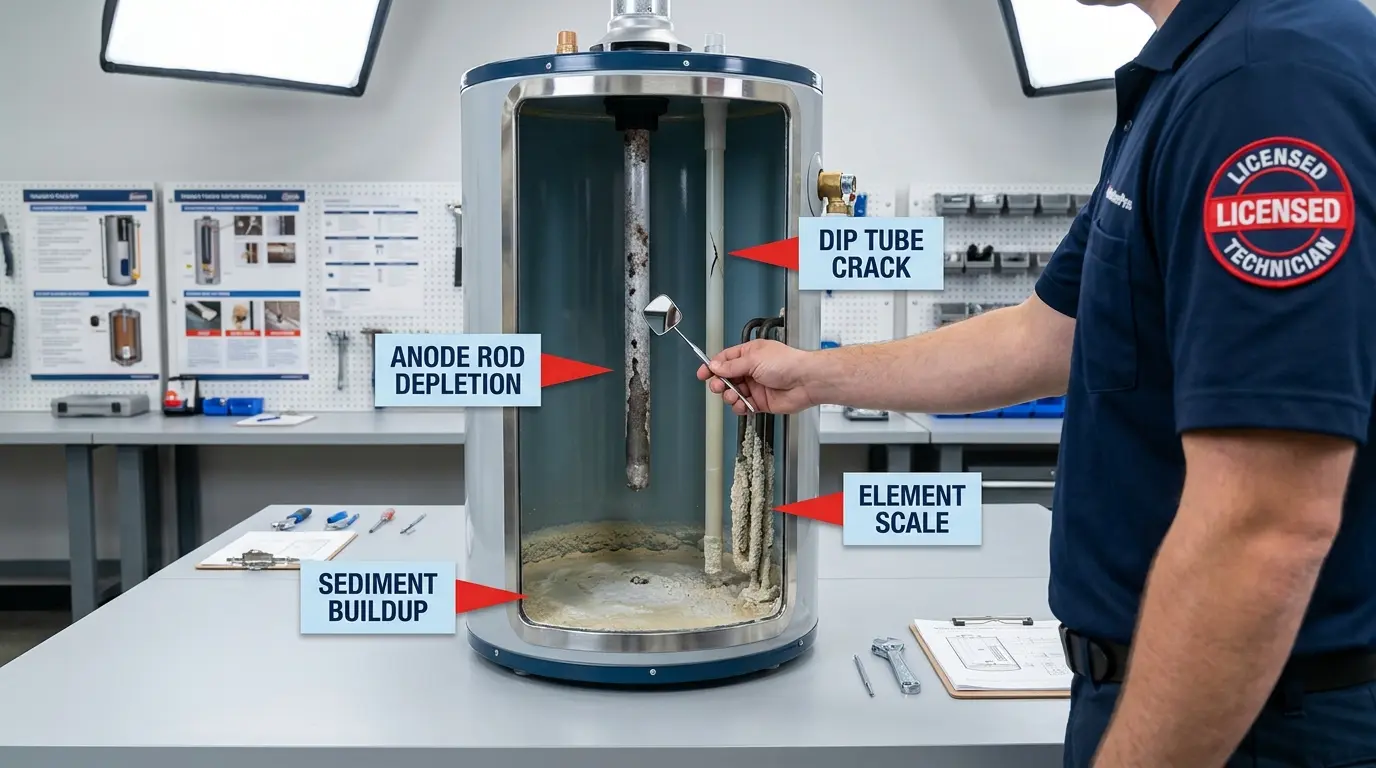
Hard Water Sediment and Anode Rod Depletion
Louisville's hard water creates two interconnected problems. Calcium and magnesium minerals settle as white, chalky sediment at the tank bottom, insulating water from the burner or heating elements. Your water heater compensates by running longer cycles, consuming more energy and overheating the tank floor until metal fatigue causes cracks. That sediment layer also traps water beneath it—water that superheats and flashes to steam, creating the popping sounds like popcorn that Louisville homeowners hear from older tanks.
The anode rod—a magnesium or aluminum core wire suspended inside the tank—sacrifices itself to protect the steel tank from corrosion. In Louisville's hard water, minerals coat the anode rod and accelerate its depletion. Anode rods here deplete every 2-3 years in softened water systems, 3-5 years in unsoftened systems, versus 5-6 years nationally. Once the anode rod depletes completely, corrosion attacks the tank itself, causing the rusty water and eventual leaks that end most water heaters' lives in Louisville.
Annual flushing removes sediment before it hardens into a concrete-like mass. Biennial anode rod inspection—and replacement when the core wire shows through—extends tank life by 3-5 years. These maintenance steps are not optional in Louisville; they are the difference between an 8-year tank failure and a 12-year service life.
Aging Housing Stock and Venting Compliance Issues
Homes built 1950-1970 in neighborhoods like Highlands, Crescent Hill, St. Matthews, Old Louisville, and Cherokee Triangle contain original galvanized steel supply pipes, cast iron drain stacks, and venting systems designed before modern codes. Galvanized pipes corrode internally, introducing rust particles that stain the water heater and clog aerators. Cast iron drains crack and leak, sometimes directly above water heaters. Venting systems shared between furnaces and water heaters often lack proper draft hood spill switches, creating backdraft risks where combustion gases spill into living spaces instead of exhausting properly.
Water heater replacement in these older homes triggers code compliance requirements. Single-wall vent connectors used before 2006 must be replaced with double-wall. Shared vents with furnaces require separation or proper Y-fitting configurations. Atmospheric vent water heaters may need conversion to power vent or direct vent systems if existing flues are undersized or deteriorated. These venting upgrades add $200-$600 to replacement costs but eliminate carbon monoxide risks.
Electrical panels in pre-1970 Louisville homes often max out at 60-100 amps, insufficient for tankless water heater upgrades without panel replacement ($1,500-$3,000). Gas lines in older homes run 1/2 inch diameter, adequate for atmospheric vent tanks but undersized for high-BTU tankless units requiring 3/4 inch lines. Understanding these infrastructure limitations before committing to equipment choices prevents mid-project surprises.
Climate Effects: Winter Demand Spikes and Summer Condensation
Louisville's Ohio River valley climate creates seasonal water heater stress. Winter incoming water temperature drops to 38-42°F December through February—20 degrees colder than summer's 60°F supply. A 40-gallon tank's effective capacity drops to approximately 25 gallons of 120°F water when fighting that temperature differential, causing Louisville families to run out of hot water during winter months even though the same tank performs adequately in summer.
Summer humidity averaging 70%+ May through September causes condensation on cold water supply lines that homeowners mistake for tank leaks. Water droplets form on the exterior of pipes carrying 60°F municipal water through 85°F basement air. This condensation collects and drips, pooling near the water heater. Distinguishing between condensation and actual tank leaks requires checking the tank itself for wetness, not just the floor—condensation wets pipes, not tanks.
Pressure Relief Valve Calcification and Thermal Expansion
The temperature-pressure relief valve (TPRV) on your water heater's side or top opens if tank pressure exceeds 150 PSI or temperature exceeds 210°F, preventing catastrophic tank rupture. Louisville's hard water calcifies these valves after 5-7 years, causing chronic dripping that wastes water and signals the valve cannot fully reseat. A dripping TPRV indicates the valve needs replacement ($150-$200) before it fails completely—either stuck open (constant water waste) or stuck closed (explosion risk).
Louisville Metro's water supply system includes backflow preventers and check valves that create closed systems where thermal expansion has nowhere to go. When water heats and expands by approximately 3% of tank volume, that pressure increase can approach 150 PSI, triggering TPRV discharge or stressing tank seams. Kentucky Plumbing Code 2024 requires expansion tanks on all closed systems. The expansion tank—a small pressurized vessel installed on the cold water supply—absorbs thermal expansion pressure, protecting the tank and preventing TPRV discharge. Homes built or repiped after 2006 should have expansion tanks; older homes often lack them, contributing to premature tank failure.
Component Failure Patterns in Louisville Water
Heating elements in electric water heaters fail faster in Louisville than softer-water regions. Mineral scale coats the element surface, insulating it from water and causing overheating that burns out the element. Upper elements fail first in most Louisville homes because they cycle more frequently; lower elements fail from sediment burial. Replacement costs $200-$350 per element including labor.
Gas valve assemblies on tank water heaters corrode faster when humidity penetrates control compartments—common in Louisville's summer months. Thermocouples—the safety device that shuts off gas flow if the pilot extinguishes—fail after 8-10 years from metal fatigue, causing pilot lights that won't stay lit. Gas igniters on newer models fail from repeated cycling in high-demand households. These component failures cost $150-$400 to repair, but on tanks 10+ years old with multiple component failures, replacement becomes more economical than continued repair.
Circuit boards in tankless water heaters and newer tank models fail from power surges and humidity exposure. Louisville's summer humidity penetrates electronic compartments, corroding solder joints. Circuit board replacement costs $250-$500 including labor, and these failures often recur unless proper venting prevents humid air intrusion. This is one reason tankless water heaters require more maintenance in Louisville than manufacturers advertise based on dryer climates.
Comprehensive Water Heater Solutions
From emergency repair to tankless upgrades, our licensed contractors handle every water heater need in Louisville with code-compliant, warranty-backed work.
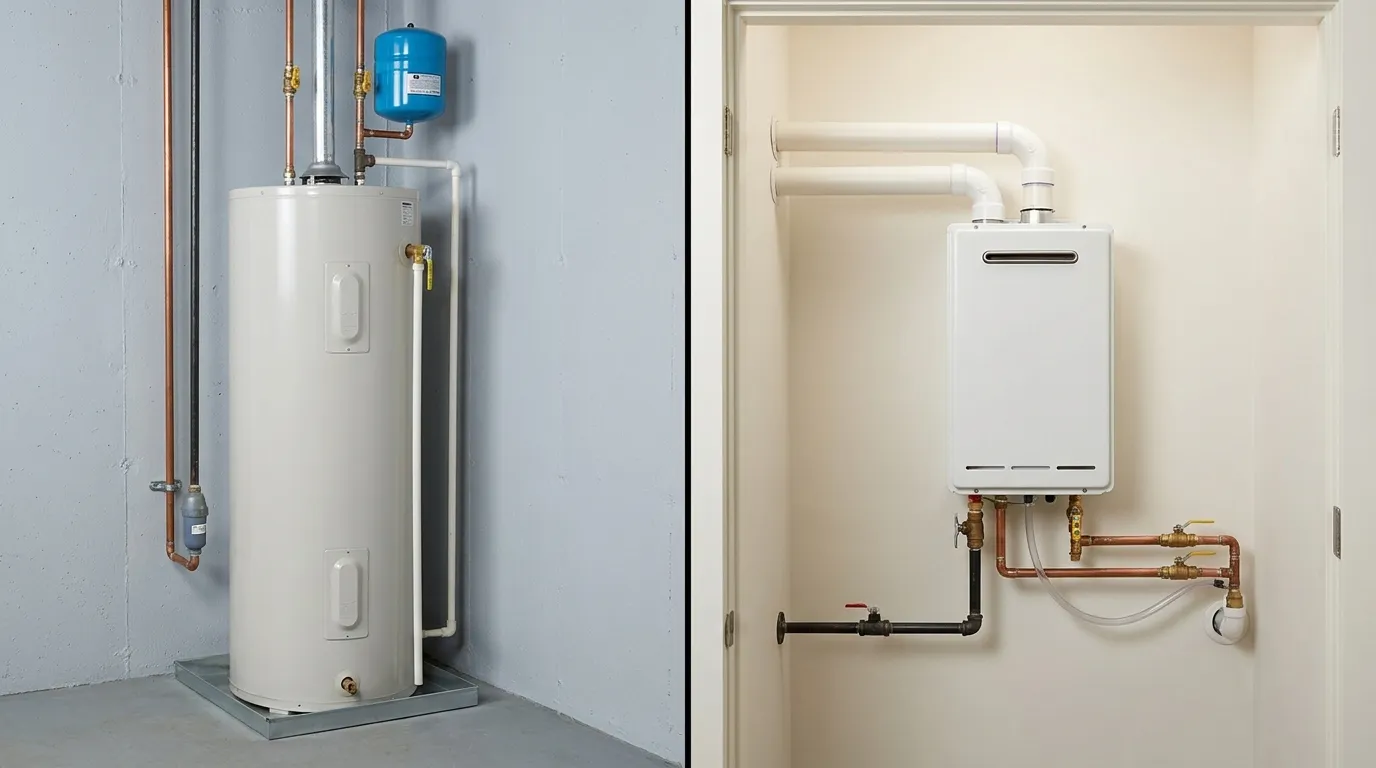
Installation
Expert sizing and installation of standard gas and electric water heaters with all permits included.
Learn More arrow_forwardRepair
Fast, reliable diagnostics and repair for leaks, no hot water, and pilot issues.
Learn More arrow_forwardTankless
High-efficiency tankless upgrades for endless hot water and space savings.
Learn More arrow_forwardMaintenance
Annual flushing and anode rod inspections to extend heater lifespan.
Learn More arrow_forward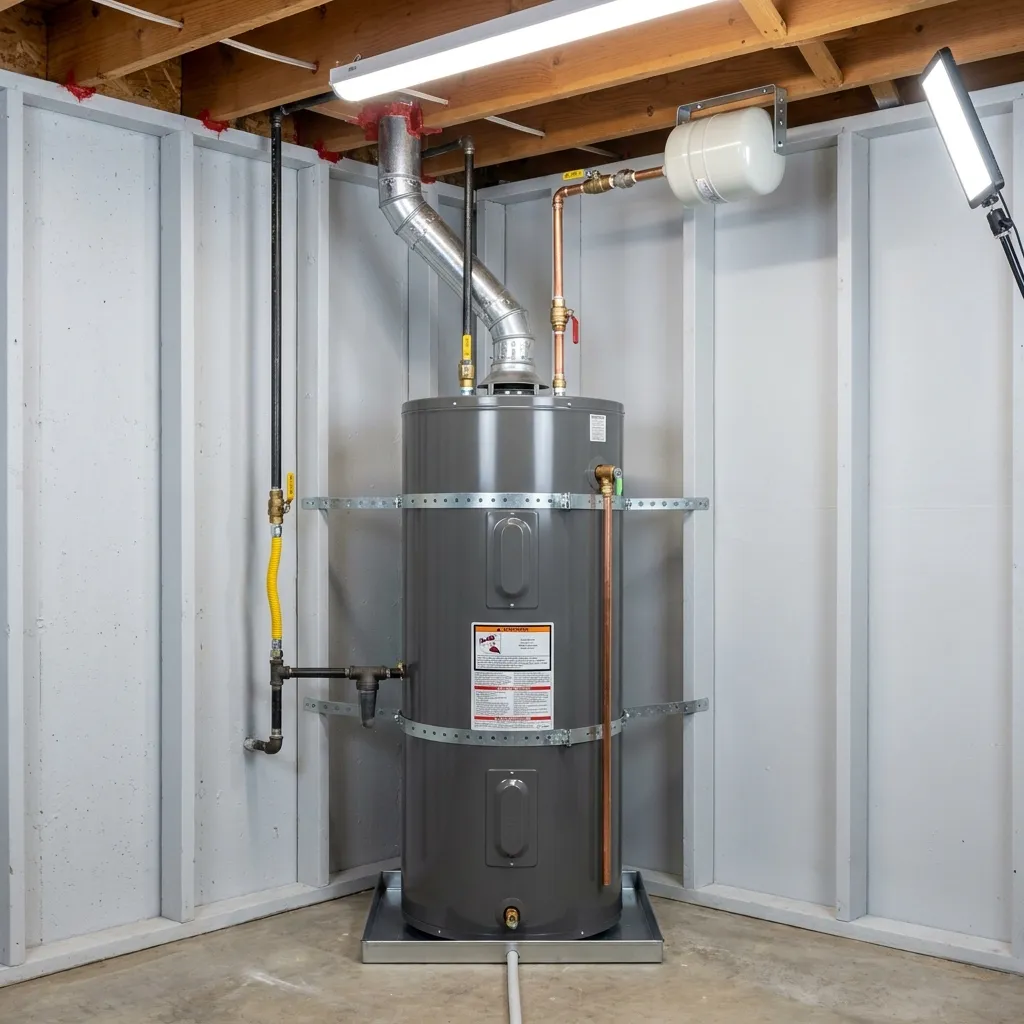
Tank Water Heater Services in Louisville
For most Louisville homes, a 40 or 50-gallon tank water heater offers the lowest upfront cost and simplest repair path, especially for homes with 1/2-inch gas lines or 100-amp electrical panels common in pre-1980 construction. Tank water heaters are the workhorses of Louisville basements, handling the city's 8-10 grain hard water better than tankless systems that can clog from mineral buildup. They work reliably with variable well water pressure in rural Jefferson County areas and don't require the 150-200 amp electrical service that tankless units demand.
Installation and Sizing for Louisville Households
A 40-gallon tank serves 1-2 people with moderate hot water use. A 50-gallon tank handles 3-4 people comfortably and is Louisville's most common residential size. Families of 5+ or homes with two full bathrooms often need 75-gallon capacity, particularly when incoming winter water temperature drops to 40°F and reduces effective capacity by 25%.
Standard atmospheric vent tanks work in most Louisville homes but require proper draft through existing flues. Power vent models use a fan to exhaust through PVC pipe, offering installation flexibility when proper chimney draft isn't available or when venting needs to terminate horizontally through a wall. Homes in historic districts like Old Louisville or Cherokee Triangle may face Certificate of Appropriateness requirements for exterior vent terminations—check with Metro Louisville Historic Preservation before finalizing vent plans.
Installation in Louisville requires a plumbing permit pulled by a Kentucky Master Plumber. The permit costs around $75-100, with total standard tank replacement running $1,200-$1,800 including equipment, labor, permit, disposal, and required code upgrades. Inspections are scheduled in order received; expect the inspector to contact you within a few days to confirm the appointment. Installations typically complete in 2-4 hours for standard tank replacements in accessible basements.
Atmospheric vs Power Vent Selection
Atmospheric vent tanks rely on natural draft—hot exhaust rises through a vertical flue connected to your chimney or vent stack. They cost $400-800 for equipment and work well when you have proper existing venting. Louisville homes built before 1980 often have single-wall vent connectors that no longer meet code; replacement requires double-wall B-vent material adding $150-300 to installation cost.
Power vent tanks cost $800-1,500 for equipment but solve venting challenges in homes where chimney draft is compromised or non-existent. The fan exhausts through 3-inch PVC pipe that can run horizontally through exterior walls, offering placement flexibility in crawlspaces or utility rooms where vertical venting isn't practical. Power vent units require a dedicated 120V electrical circuit and make a low hum when operating—typically not noticeable if installed in basement or garage.
Gas vs Electric Tank Comparison
Gas tanks (natural gas or propane) heat water faster and cost less to operate in Louisville where LG&E natural gas rates average $0.80-1.20 per therm. A 50-gallon gas tank recovers in 45-60 minutes after full depletion versus 90-120 minutes for electric. Gas equipment costs $500-1,000, requires proper combustion air and venting, and needs a 1/2-inch gas line (standard in most Louisville homes). Annual maintenance includes checking the pilot assembly, cleaning the burner, and inspecting the flue for blockages.
Electric tanks cost $400-700 for equipment and work anywhere you have 240V service—no venting required. They're ideal for Louisville homes without gas service or when venting installation would be prohibitively expensive. Operating costs run $40-60 per month versus $25-35 for gas, but installation is simpler and typically $200-300 less expensive since no venting work is needed. Electric tanks have two heating elements (upper and lower); when one fails, you'll get lukewarm water instead of no hot water.
Repair: Common Component Failures
Most Louisville tank repairs involve the heating mechanism—thermostats, elements, gas valves, or thermocouples. Thermostat replacement costs $180-250 and fixes temperature control issues where water runs too hot or too cold. Heating element replacement (electric tanks) runs $200-350 and addresses no-heat or insufficient-heat problems. Gas valve replacement costs $300-400 and is necessary when the pilot won't stay lit despite a good thermocouple.
Pressure relief valve replacement ($150-200) is common in Louisville's hard water. The TPRV (temperature-pressure relief valve) prevents dangerous pressure buildup but calcifies in hard water and starts dripping constantly—that's your signal to replace it before it fails closed and creates a safety hazard. The discharge pipe must terminate within 6 inches of the floor per Kentucky code.
Anode rod replacement ($150-250) extends tank life by 3-5 years if caught early. This sacrificial magnesium or aluminum rod corrodes instead of the tank—when depleted, rust attacks the steel tank and you'll see rusty water. In Louisville's hard water, check anode rods every 2-3 years instead of the manufacturer's 4-5 year interval. If the tank hasn't been flushed regularly, removing a corroded anode rod becomes difficult or impossible.
Replacement Timeline: When Repair Doesn't Make Sense
Replace rather than repair when the tank leaks from its body or bottom—these leaks mean internal corrosion has created holes. No repair fixes a rusted-through tank. Age 10+ years, even if working, warrants preemptive replacement in Louisville given the 8-10 year typical lifespan here versus 12 years nationally. Hard water accelerates internal corrosion 30-40% faster than softer water areas.
Multiple component failures (heating element + thermostat + TPRV all within 6 months) suggest the tank is near end-of-life. When repair costs approach 50% of new tank cost, replacement makes better economic sense. Rusty water combined with sediment and rumbling noises indicates advanced internal tank corrosion—you're on borrowed time.
Insufficient capacity (running out of hot water despite working components) calls for a size upgrade. Don't repair a 40-gallon tank if your family needs 50 gallons. Consider that winter incoming water temperature in Louisville drops to 40°F, reducing effective capacity 20-25%—a 40-gallon tank delivers about 30 gallons of 120°F water in January versus 35-36 gallons in July.
Maintenance: Extending Tank Life in Louisville's Hard Water
Annual sediment flushing is critical in Louisville, not optional. Hard water deposits 40% more sediment than soft water, creating an insulating layer between burner and water that forces the tank to run longer and hotter to meet demand. That extra heat accelerates tank bottom corrosion. Flush procedure: shut off power/gas, close cold water inlet, attach garden hose to drain valve, run water until clear (5-10 minutes), refill tank, restart system.
Anode rod inspection every 2-3 years catches depletion before rust attacks the tank. If more than 6 inches of core wire is exposed or the rod is less than 1/2 inch thick, replace it. Cost: $150-250 for replacement including labor. Some Louisville contractors include anode rod checks with annual maintenance visits—ask when scheduling service.
Test the pressure relief valve annually by lifting the lever and letting water discharge briefly—this confirms the valve isn't stuck closed. If no water flows or the valve won't reseal after testing, replace it immediately. Temperature adjustment to 120°F reduces sediment formation and extends tank life while preventing scalding risk.
Expansion tank inspection (if present) includes checking air pressure and looking for waterlogging. Expansion tanks are required in Louisville when your water supply system is closed (has backflow preventers or check valves). A failed expansion tank causes excessive TPRV discharge and premature tank failure from overpressure. Replacement costs $150-200 installed.
Code Requirements in Louisville
Kentucky Plumbing Code 2024 requires expansion tanks on closed water supply systems. If you have backflow preventers on your water main (standard in Louisville municipal water connections), you need an expansion tank. Most pre-2006 installations lack them—replacement triggers this upgrade.
TPRV discharge piping must be approved material (copper or CPVC), slope continuously downward, terminate within 6 inches of floor, and not be capped or routed upward. Many older Louisville installations have improper discharge piping—inspectors flag this.
Water heaters installed in attics, above drop ceilings, or on wood flooring after April 1, 2021 require corrosion-resistant watertight pans with 3/4-inch drains piped similarly to TPRV discharge. Most Louisville tank installations are in basements or garages where pans aren't mandatory unless installed on finished flooring.
Gas appliances need adequate combustion air—typically 50 cubic feet per 1000 BTU input. Louisville homes with tight envelope construction (spray foam insulation, sealed crawlspaces) may need supplemental combustion air vents. Inspectors verify this during permit inspections.
Call +1-888-387-1216 for a tank water heater quote or to schedule annual maintenance that protects your investment in Louisville's challenging hard water conditions.
Tankless Water Heater Services in Louisville
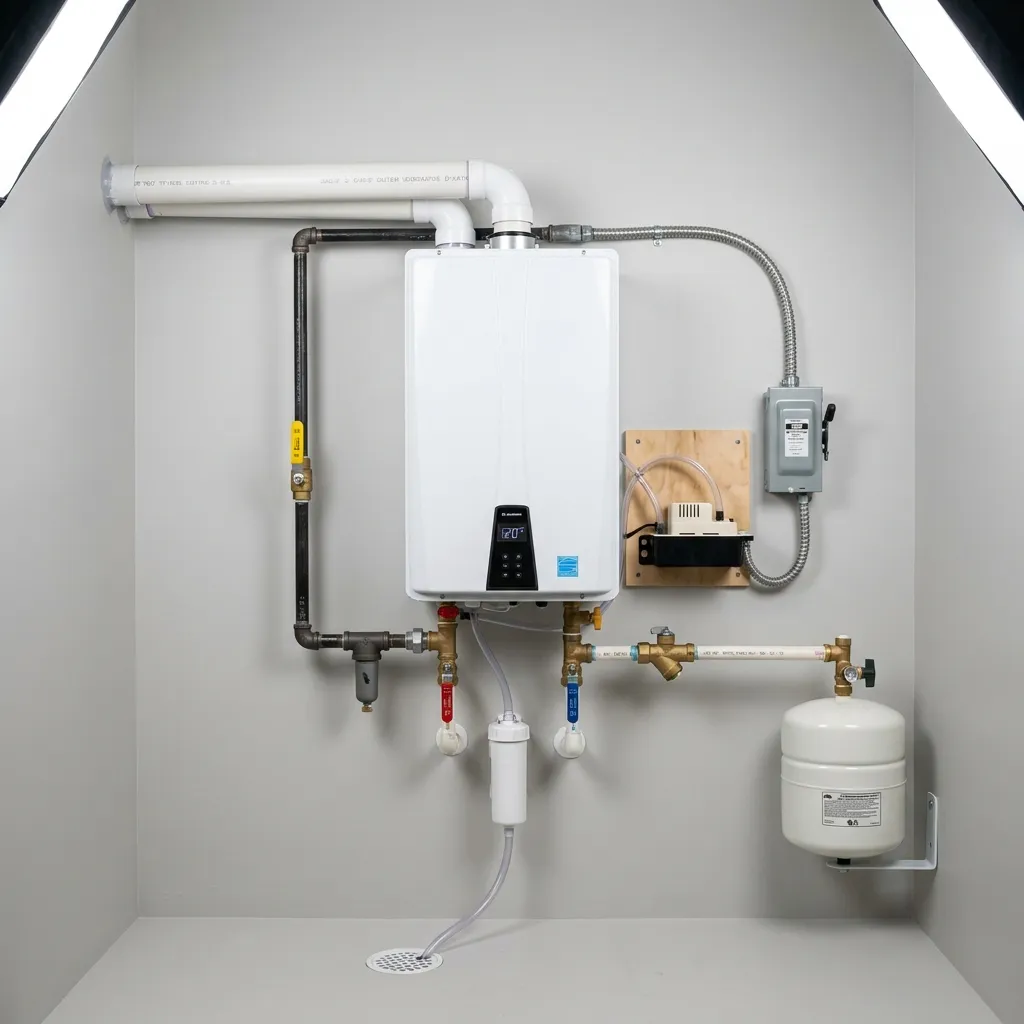
Tankless water heaters provide endless hot water and last 20+ years, but they require expensive gas line or electrical upgrades in many older Louisville homes. Before you commit to tankless, understand that most pre-1990 homes in neighborhoods like Highlands, Crescent Hill, St. Matthews, Old Louisville, and Cherokee Triangle need $1,500-$3,000 in electrical panel upgrades or $500-$1,200 in gas line upsizing to support the 180,000-200,000 BTU demand of whole-house gas tankless units or the 150+ amp circuits electric units require. Louisville's 8-10 grain hard water also demands annual descaling maintenance that costs $150-$200 per visit—skip it and mineral buildup clogs the heat exchanger, voiding your warranty.
Installation Requirements for Louisville Homes
Gas tankless units require a 3/4-inch gas line minimum for 180,000 BTU models—most Louisville homes built before 1990 have 1/2-inch lines sized for 40,000 BTU tank units. Upsizing that gas line from your meter to the water heater location runs $500-$1,200 depending on distance and accessibility. You also need a dedicated 15-20 amp 120V electrical circuit for the ignition system and control board, even on gas models. Electric tankless units demand 100-150 amp circuits (240V) for whole-house capacity, which exceeds the electrical panel capacity in most homes built before 1970. Panel upgrades cost $1,500-$3,000 in Louisville.
Venting presents another challenge. Condensing tankless models use PVC vent pipes that can run horizontally through exterior walls—simpler and cheaper for most Louisville installations. Non-condensing models require stainless steel venting that must extend vertically through the roof like traditional tank water heaters, adding $300-$800 to installation costs. Neither can share a vent with your furnace per Kentucky Plumbing Code 2024, so homes with shared venting systems need new dedicated vent runs.
Gas vs Electric Tankless: Louisville Cost Reality
Gas tankless units cost $2,500-$4,500 installed in Louisville when you factor in gas line upgrades, venting, electrical circuits, permit fees, and labor. Electric tankless units run $2,200-$3,800 installed but usually require panel upgrades that push total cost above gas models. The equipment itself costs $800-$1,800 for gas units rated 180,000-199,000 BTU (sufficient for 2-3 simultaneous fixtures), or $500-$1,500 for electric units rated 18-36 kilowatts.
Energy savings with Louisville Gas & Electric rates (currently $1.33 per therm for gas) typically amount to $120-$180 annually compared to standard tank water heaters. That means a 15-20 year payback period on the upfront premium for gas tankless. Electric tankless offers no energy savings—electricity costs more per BTU than gas in Louisville, so you pay for endless hot water with higher monthly bills unless you have solar panels offsetting consumption.
Cold Water Sandwich Effect and Flow Rate Reality
Tankless units deliver hot water on demand, but Louisville's January groundwater temperature drops to 40-42°F. At that temperature, a 9 GPM rated tankless unit actually delivers only 5-6 GPM when raising water to 120°F. Run a shower (2.5 GPM) and a dishwasher (2 GPM) simultaneously in January and you'll experience the cold water sandwich effect: hot water when you first turn on the tap, then a burst of cold water as the unit cycles, then hot again once it stabilizes. Proper sizing requires calculating simultaneous demand plus 20% buffer for Louisville winter temperatures—most families need 180,000+ BTU gas units or 24+ kilowatt electric units for whole-house coverage.
Annual Descaling Maintenance is Non-Negotiable
Louisville's 8-10 grain hard water deposits calcium carbonate inside the tankless heat exchanger every time water passes through. Skip annual descaling and mineral buildup restricts flow, triggers error codes, reduces efficiency, and eventually cracks the heat exchanger—a $800-$1,500 repair that most warranties won't cover if you can't prove annual maintenance. Professional descaling costs $150-$200 in Louisville and involves pumping vinegar solution through the system for 45-60 minutes. DIY descaling kits cost $30-$40 but require following manufacturer procedures exactly to avoid voiding warranty.
Outdoor tankless units installed in Louisville's climate zones need freeze protection systems or must be drained completely October-April. Indoor installations in unheated garages or crawlspaces face the same freeze risk—burst heat exchangers aren't covered by warranty.
Repair Costs Run Higher Than Tank Units
Tankless water heaters have circuit boards, flow sensors, flame rods, mixing valves, and heat exchangers that cost $200-$500 per component plus $100-$150 labor per hour. Average repair costs in Louisville run $250-$500 versus $150-$300 for tank water heater repairs. Circuit board failures are common after 7-10 years and cost $300-$400 to replace. Flow sensors clog with sediment despite annual descaling in Louisville's hard water—replacement runs $150-$250. Gas valve failures cost $250-$350.
Extended warranties covering parts and labor for 5-10 years cost $300-$600 upfront but eliminate surprise repair bills. Without extended coverage, expect $200-$400 annual repair costs starting around year 8-10.
When Tankless Makes Sense in Louisville
Tankless water heaters work well for Louisville families who:
- Have large households (5+ people) with high hot water demand
- Own newer homes (post-1990) with 150+ amp electrical service and 3/4-inch gas lines already in place
- Plan to stay in the home 15+ years to recoup upfront investment
- Have space constraints requiring wall-mounted installation
- Commit to annual descaling maintenance to protect the heat exchanger
Tankless doesn't make financial sense if your home needs electrical panel upgrades, gas line upsizing, or you're selling within 10 years. In those cases, a high-efficiency tank water heater (0.67+ energy factor) offers 90% of the energy savings at 40% of the upfront cost.
Call +1-888-387-1216 for a tankless consultation that includes an honest assessment of your Louisville home's electrical capacity, gas line sizing, venting options, and total installed cost before you commit to the upgrade.
Tank or Tankless: What's Right for Your Louisville Home?
Answer 7 questions for a personalized recommendation based on your home, budget, and hot water needs.
Question 1 of 7 — Budget (25% weight)
What's your budget range for a new water heater?
Considering a tankless water heater upgrade for your Louisville home? Our licensed contractors in Jefferson County help you evaluate whether tank or tankless is the right fit based on your household size, gas line capacity, and local water conditions. Every estimate includes a free written quote with no obligation. Call +1-888-387-1216 to schedule your assessment.
24/7 Emergency Services in Louisville
Emergency Water Heater Services in Louisville
If you have no hot water, a burst tank, or a gas leak in Louisville, our 24-hour emergency team can arrive in 20-40 minutes to most Jefferson County neighborhoods to stop the damage and restore safety. We dispatch immediately when you call +1-888-387-1216—no waiting until morning, no after-hours voicemail. A Louisville water heater emergency at 2 a.m. gets the same fast response as a Tuesday afternoon call.
What Qualifies as a Water Heater Emergency
We stop the flood. Active water spreading across your basement floor from a ruptured 40-50 gallon tank requires immediate containment. We shut off the water supply at the tank inlet valve or main shutoff, contain the flooding with emergency pumps and barriers, disconnect power or gas to prevent secondary hazards, and assess whether the tank can be repaired or needs replacement. Most ruptured tanks in Louisville fail catastrophically—the sediment buildup from hard water weakens the steel until internal pressure causes a rupture. When that happens, you have minutes before water damage spreads to flooring, walls, and stored belongings.
We fix the heat—fast. Complete loss of hot water during Louisville's winter months (December-February when incoming water drops to 38-42°F) leaves families without showers, dishwashing capability, or laundry. If your pilot light won't stay lit, your circuit breaker trips repeatedly, or your tankless unit displays an error code and shuts down, we diagnose the root cause and restore hot water the same day. Most no-hot-water calls trace to failed thermostats ($180-$250 repair), burned-out heating elements ($200-$350 repair), or extinguished pilot lights with failed thermocouples ($150-$180 repair). We carry these components on every service truck.
We contain gas leaks. If you smell gas—a sulfur or rotten-egg odor—near your water heater, evacuate immediately and call 911, then Louisville Gas & Electric at (502) 589-1444. Once LG&E confirms the area is safe, call us at +1-888-387-1216 to repair the gas valve, pilot assembly, or supply line connection that caused the leak. We do not attempt gas work until the utility company clears the scene. Carbon monoxide situations follow the same protocol: evacuate, call 911, then call us once fire department confirms it's safe to re-enter. Backdrafting from a blocked flue or cracked heat exchanger sends combustion gases into your home instead of outside.
Louisville Response Times by Area
Downtown Louisville, Highlands, Crescent Hill, St. Matthews, Old Louisville, Cherokee Triangle: 15-25 minutes typical response from our central Jefferson County shop. These dense neighborhoods allow quick access via I-65, I-64, I-264 (Watterson Expressway), and surface streets.
East End (Middletown, Jeffersontown, Hurstbourne, Corporate Campus areas near Forum): 25-35 minutes response. Traffic on I-64 eastbound and Shelbyville Road can add 5-10 minutes during evening rush (4:30-6:30 PM).
South Louisville (Okolona, Highview, Fern Creek): 20-30 minutes via I-65 southbound or Outer Loop (I-265).
West Louisville (Shively, Valley Station, Pleasure Ridge Park): 25-35 minutes via I-264 westbound.
I-65 closure impact (June 1-July 31): The central I-65 corridor between I-264 and downtown Jefferson Street is closed for bridge replacement, affecting 120,000+ daily drivers. Emergency calls routing through this zone add 10-15 minutes while we detour via I-264. Once the closure lifts in August, normal response times resume.
Peak traffic hours (7:00-8:45 AM, 4:30-6:30 PM) add 5-15 minutes citywide. Ohio River bridge congestion (I-65 downtown bridges, Second Street Bridge) and Watterson Expressway backups through the east side slow response during rush periods. Off-peak and overnight calls (9 PM-6 AM) receive fastest response—often 15-20 minutes across most of Jefferson County.
After-Hours and Weekend Pricing
Emergency service after 5 PM weekdays, weekends, and holidays includes a $150-$200 premium above standard repair rates. A thermostat replacement that costs $180-$250 during business hours runs $280-$400 after hours. This premium covers immediate dispatch, technician overtime, and parts pulled from emergency inventory rather than waiting for distributor hours. We quote the total cost before starting work—no surprises when you get the invoice.
Same-day emergency tank replacement runs $1,400-$2,000 all-in (50-gallon gas or electric) after hours, versus $1,200-$1,800 during business hours. The premium reflects pulling a Kentucky Master Plumber from on-call status, acquiring a same-day permit from Jefferson County (inspections scheduled next business day), and completing the 2-4 hour installation outside normal working hours.
Emergency Safety Protocols
Water shutoff: Tank inlet valve (cold water supply at top of tank) turns clockwise to close. If corroded or stuck, shut off main water supply—typically located near water meter in basement, crawlspace, or outside meter pit. Shut off power to electric water heaters at breaker panel before standing in water near the unit. Shut off gas supply at manual shutoff valve on gas line feeding water heater (quarter-turn perpendicular to pipe closes gas flow).
Gas leak response: Do not flip light switches, use phones inside the home, or operate any electrical devices—sparks can ignite gas. Evacuate immediately. Call 911 and LG&E from outside. Do not re-enter until cleared by emergency responders.
Electrical disconnect: If water is pooling near an electric water heater, shut off power at breaker panel before approaching the unit. Electric shock risk is serious when standing in water near 240-volt heating elements.
Carbon monoxide: Leave home immediately if CO alarm sounds. Call 911. Do not attempt to diagnose the water heater until fire department tests air quality and clears the scene. Blocked flues, cracked heat exchangers, and backdrafting all cause CO buildup.
What We Bring to Every Emergency Call
Replacement thermostats (single and dual-element for electric tanks), heating elements (standard and low-watt-density), thermocouples, gas valves, pressure relief valves, anode rods, igniters, and circuit boards for common tankless brands. Diagnostic tools: multimeter for electrical testing, manometer for gas pressure verification, combustion analyzer for flue draft testing, inspection camera for internal tank corrosion assessment. Leak containment: portable sump pump, wet/dry vacuum, absorbent barriers, moisture meter for drywall damage assessment.
Call +1-888-387-1216 now for Louisville emergency water heater service—we answer 24/7, dispatch immediately, and arrive ready to stop the damage and restore hot water the same day.
Water Heater Installation in Louisville
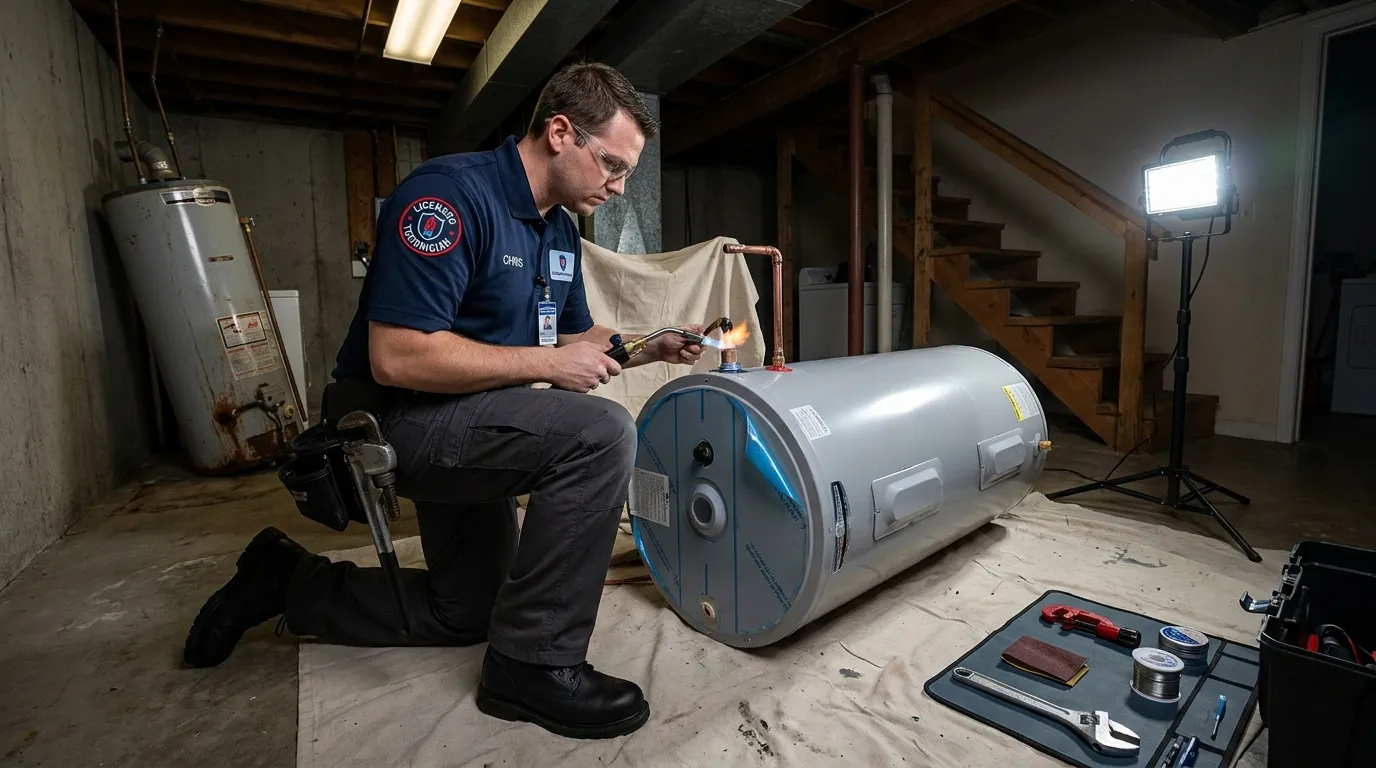
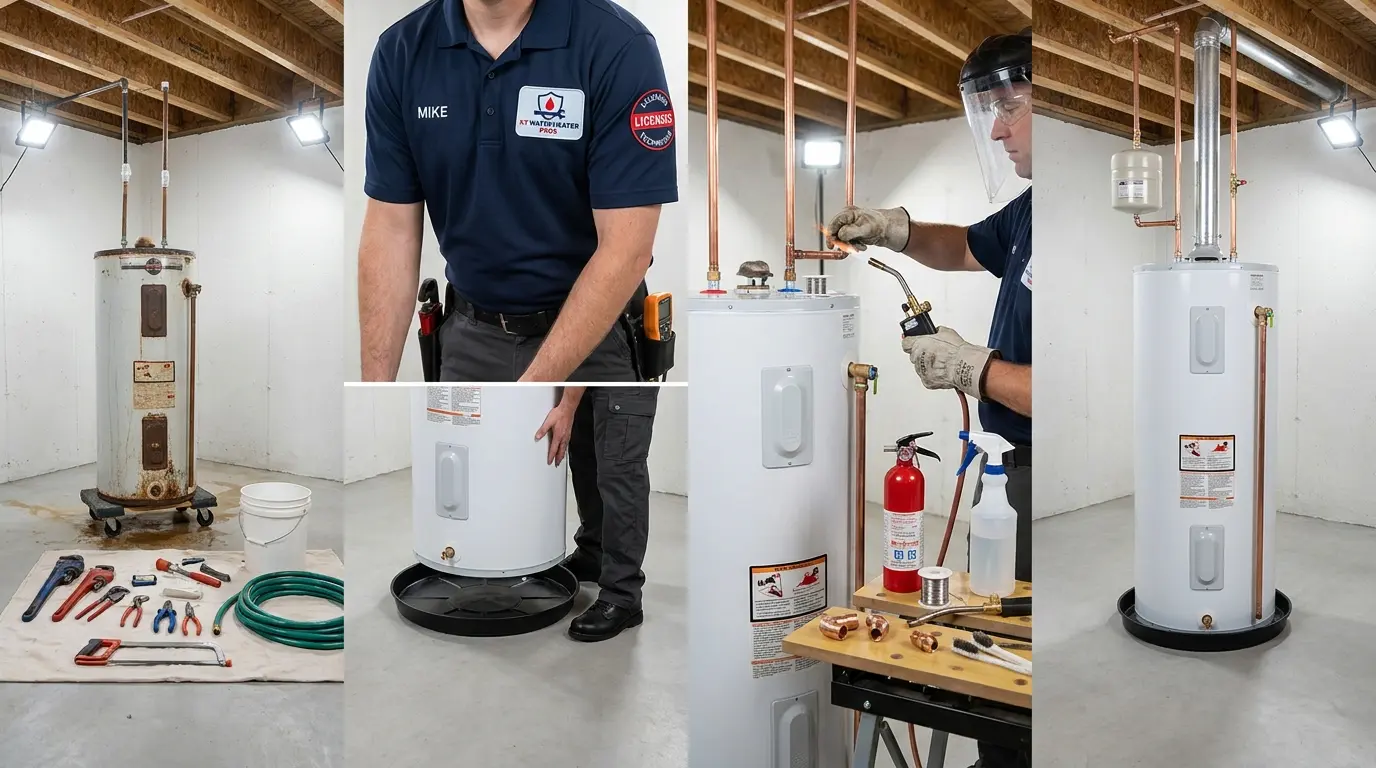
Most standard tank replacements in Louisville take 2-4 hours, but you should budget a full morning to account for Jefferson County permit pickup, gas line testing, and code upgrades that weren't required when your old unit was installed. The old tank comes out. The new code-compliant piping goes in. The inspector verifies everything meets Kentucky's 2024 plumbing code before you get hot water flowing again.
The Louisville Permit Process
Water heater replacement in Louisville requires a plumbing permit pulled by a Kentucky Master Plumber. You cannot legally install a water heater yourself or hire an unlicensed handyman—the permit office at Louisville Metro Government's Construction Review division verifies the contractor's license before issuing the permit. The permit costs approximately $75-$125 as part of the total installation package, which typically runs $1,700-$1,800 all-in for a standard 50-gallon tank including equipment, labor, permit, disposal, and code upgrades.
After installation, you schedule an inspection by calling (502) 574-4449. The inspector contacts you within a few days to confirm the appointment—inspections are processed in order received. The inspector verifies proper venting, gas line connections, TPRV discharge piping, expansion tank installation if required, and electrical or gas shutoff valve placement. No inspection means no legal installation, and your homeowner's insurance may deny claims for water damage from an unpermitted water heater.
Code Upgrades Triggered by Replacement
Installing a new water heater triggers compliance with current Kentucky Plumbing Code even when your old unit was grandfathered under previous standards. Expect these upgrades:
Expansion Tank ($150-$200): Required if your water supply system is closed—meaning it has backflow preventers or check valves that prevent thermal expansion from pushing back into the city main. Most Louisville homes built after 2000 and many retrofitted older homes need expansion tanks. Without one, pressure buildup from heated water can damage fixtures, pipes, and the water heater itself.
TPRV Discharge Piping ($75-$150): The temperature-pressure relief valve discharge pipe must be rigid copper, CPVC, or another approved material that slopes continuously downward and terminates within 6 inches of the floor. It cannot route upward, cannot be capped, and must discharge to a floor drain, outside termination, or other approved location. Many older Louisville homes have galvanized steel discharge pipes that corrode or terminate into a bucket—neither meets current code.
Drain Pan Installation ($100-$150): Water heaters installed in attics, above drop ceilings, or on wood flooring after April 1, 2021 require a corrosion-resistant watertight pan with a 3/4-inch drain line piped similarly to the TPRV discharge. This catches slow leaks before they damage ceilings or floors. Basement installations on concrete typically don't require pans unless the water heater sits in a finished area or above living space.
Venting Compliance ($200-$600): Atmospheric vent water heaters require double-wall Type B vent connectors from the draft hood to the chimney or vent stack. Single-wall connectors were common in pre-2006 installations but no longer meet code. Power vent and direct vent units have their own specific venting requirements. Shared venting with a furnace may require separation or upsizing depending on total BTU load.
Gas Line Pressure Testing: The installer must pressure-test gas piping before connecting the new unit and verify proper operation of the gas valve, burner assembly, and pilot or electronic ignition. This confirms no leaks exist and the supply delivers adequate pressure.
Preparing for Installation Day
Clear a path to your water heater. The installer needs to carry a 200+ pound tank down basement stairs or through hallways. Move boxes, stored items, laundry, or furniture blocking access. If your water heater is in a crawlspace, ensure the access panel is clear and any debris around the unit is removed.
Turn off the water heater the night before if scheduling a morning installation—this gives the tank time to cool, speeding up drain-down. Have your old utility bills available so the installer can verify you're getting the right size replacement. A family that's outgrown a 40-gallon tank doesn't want another 40-gallon tank installed just because that's what was there before.
Expect water service interruption for 2-4 hours during installation. Plan accordingly—no showers, dishwasher, or laundry during that window. Gas service to the water heater will be shut off during installation but other gas appliances like your furnace or stove remain operational.
Old Unit Disposal
Your installer hauls away the old tank as part of the service. Louisville contractors typically charge $25-$50 for disposal, often included in the quoted installation price. The old tank goes to a metal recycling facility—it's not legal to leave it curbside for trash pickup due to weight and potential residual water or gas. Confirm disposal is included in your quote before signing the work order.
Timeline From Call to Hot Water
Here's the realistic Louisville installation timeline:
Day 1, Morning: You call for service. The contractor schedules a site visit to assess the installation, measure space, verify venting, check gas line size, and provide a written quote.
Day 1 or 2: You approve the quote. The contractor orders equipment (next-day delivery for common sizes; 2-3 days for less common models like 75-gallon tanks or specific brands).
Day 3-5: Contractor pulls the permit from Louisville Metro Government. Permit processing takes 1-2 business days if the contractor's license is current and paperwork is complete.
Day 5-7: Installation day. Contractor arrives, drains and disconnects old unit, installs new unit with code-compliant upgrades, tests operation, and schedules the inspection.
Day 6-10: Inspector arrives, verifies code compliance, signs off on permit. You get the signed permit card to keep with your home records.
Emergency replacements for failed units compress this timeline—equipment in stock gets installed same-day or next-day, permit gets pulled simultaneously, inspection follows within 2-3 business days.
What You Pay For
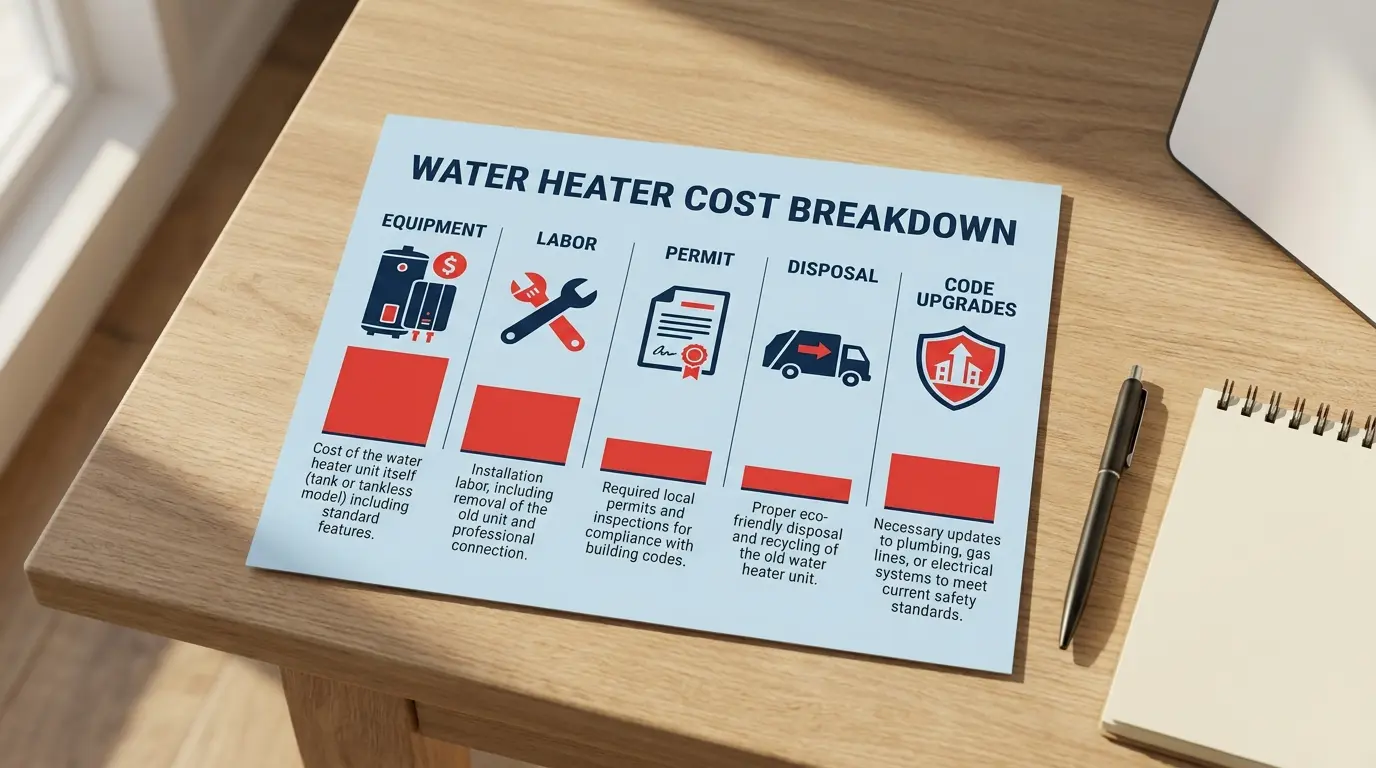
The $1,700-$1,800 typical Louisville installation cost breaks down as:
- Equipment: $400-$800 (50-gallon standard atmospheric vent gas tank)
- Labor: $400-$600 (2-4 hours at $150-$200/hour)
- Permit: $75-$125
- Code upgrades: $225-$350 (expansion tank, TPRV discharge, venting)
- Disposal: $25-$50
Power vent, tankless, or 75-gallon tanks increase equipment cost. Gas line or electrical upgrades for tankless installations add $500-$3,000 depending on scope. Crawlspace installations add $100-$200 labor premium due to difficulty. Always get the total price in writing before work begins—surprises during installation should trigger a conversation and revised quote, not an invoice shock when the job is done.
Call +1-888-387-1216 to schedule a site assessment. We'll measure your space, check your gas line and venting, explain what code upgrades your home needs, and provide a written quote with no surprises on installation day.
Water Heater Installation in Louisville
Whether you're replacing a failing unit or upgrading to a more efficient model, our licensed contractors handle the entire installation process — from pulling permits to scheduling the final city inspection.
Permits & Code Compliance
We pull all required Louisville permits. Installations include expansion tanks, TPRV discharge piping, and proper venting per current Kentucky code.
Old Unit Removal
We disconnect, drain, and haul away your old water heater. All disposal is environmentally compliant — included in every installation quote.
Gas & Electric Options
We install both gas (atmospheric & power vent) and electric water heaters. We'll recommend the right size — 40, 50, or 75 gallon — based on your household demand.
Final Inspection
After installation, we schedule the city/county inspection for you. We stay until the inspector signs off — ensuring everything passes on the first visit.
Installation Timeline
Day 1: Assessment
We inspect your current setup, measure for the new unit, and provide a written quote.
Day 1–2: Permit & Parts
We pull the permit and source the exact water heater model you selected.
Day 2–3: Installation
Most installations complete in 3–5 hours, including removal, connections, and testing.
Day 3–5: Inspection
City/county inspector verifies code compliance. We handle the scheduling.
Water heater installation in Louisville, KY requires proper permitting through theJefferson County building department. Our contractors pull all required permits, install to current Kentucky plumbing code, and schedule the final inspection on your behalf. Expansion tanks, TPRV discharge piping, and code-compliant venting are included in every installation. Get your free installation quote at +1-888-387-1216.
Water Heater Repair in Louisville
If your water heater is less than 6 years old and isn't leaking from the tank itself, a repair in Louisville is likely the most cost-effective choice. Component failures—thermostat burnout, heating element corrosion, gas valve malfunction—typically cost $150-$400 to fix versus $1,200-$1,800 to replace the entire unit. But Louisville's 8-10 grain hard water complicates the repair-versus-replace decision because sediment accelerates wear on every moving part, and units older than 8 years often fail again within months of a repair.
When Repair Makes Sense in Louisville
Repair the water heater when it's under 6 years old, still under manufacturer warranty, and the failure involves a single replaceable component. A $250 thermostat replacement on a 4-year-old water heater buys you another 4-6 years of service. A $180 thermocouple replacement on a 5-year-old gas unit restores pilot light function for years. These repairs deliver positive return on investment because the tank itself remains structurally sound.
Louisville water heater contractors diagnose common repairable failures:
Thermostat failure: Electric water heaters use dual thermostats (upper and lower). When one fails, you get lukewarm water or the circuit breaker trips repeatedly. Replacement costs $180-$250 including the diagnostic visit. The upper thermostat controls both elements; the lower controls only the bottom element. Sediment buildup from Louisville's hard water causes thermostats to misread temperature and cycle improperly.
Heating element burnout: Electric heating elements corrode faster in Louisville's mineral-heavy water—calcium carbonate coats the element surface, insulating it from the water and causing it to overheat and fail. Replacing one element costs $200-$350. If both elements fail simultaneously on a unit over 8 years old, replacement makes more financial sense than $400-$600 in repairs.
Gas valve malfunction: The gas control valve regulates burner operation. When it fails, you get no hot water, pilot light won't stay lit, or inconsistent water temperature. Replacement costs $300-$400. Gas valves rarely fail on units under 7 years old—if yours does, it's usually covered by manufacturer warranty.
Thermocouple replacement: This safety device shuts off gas flow if the pilot light extinguishes. They fail mechanically over time, not from water quality. Replacement costs $150-$180. This is the most straightforward repair—takes 20-30 minutes and restores full function.
Pressure relief valve: The temperature-pressure relief valve (TPRV) prevents tank rupture by releasing pressure if temperature or pressure exceeds safe limits. Louisville's hard water calcifies the valve seat, causing constant dripping. Replacement costs $150-$200. A dripping TPRV wastes water and signals the valve won't function properly in an overpressure emergency.
Anode rod replacement: This sacrificial magnesium or aluminum rod attracts corrosive elements that would otherwise attack the steel tank. In Louisville's hard water, anode rods deplete in 2-3 years versus 5-6 years in softer water. Replacement costs $200-$300. If you catch anode rod depletion before the tank starts rusting, you can extend tank life by 3-5 years. Once you see rusty water, the tank interior has already corroded—replacement is the only option.
When to Replace Instead of Repair
Replace the water heater when the tank itself leaks, the unit is 10+ years old, multiple components fail simultaneously, or repair costs approach 50% of replacement cost. A leaking tank cannot be repaired—the steel has rusted through and will continue to deteriorate. In Louisville, where water heaters average 8-10 year lifespans due to hard water stress, a leak on an 8-year-old tank means you're within months of catastrophic failure even if you patch it temporarily.
Age-based replacement guidance: At 8 years old, even a working water heater in Louisville enters high-risk territory. Sediment has accumulated. The anode rod is depleted. The tank's glass lining has developed microfractures. A $300 repair on an 8-year-old unit buys you 6-18 months before another component fails or the tank ruptures. That $300 becomes money lost when you replace the unit 12 months later.
Multiple-failure replacement: When you face $400+ in repairs—say, a gas valve and thermocouple replacement together, or both heating elements plus a thermostat—replacement makes more sense. You're spending 25-33% of a new water heater's cost to repair an aging unit that will require more repairs within 12-24 months.
Capacity upgrade replacement: If your household has grown and you're running out of hot water constantly, repairs don't solve the problem. Upgrading from a 40-gallon to 50-gallon tank costs the same as a 40-gallon replacement—$1,200-$1,800 installed. The incremental cost is zero, but the quality of life improvement is substantial.
The Louisville Repair Process
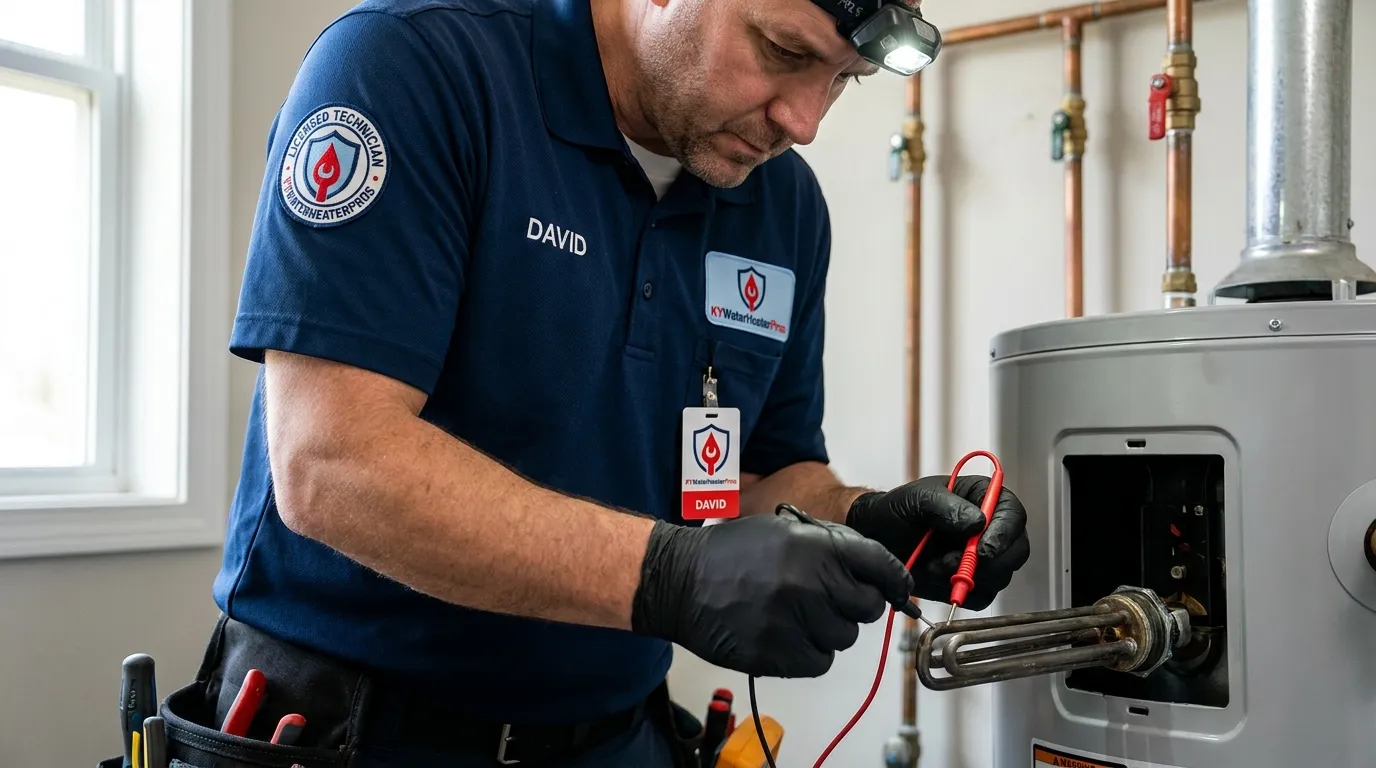
Licensed contractors diagnose water heater problems systematically. They test electrical voltage at thermostats and heating elements with a multimeter. They check gas valve operation and flame sensor continuity. They drain sediment to see how much has accumulated. They inspect the anode rod condition (if accessible). They pressure-test the TPRV. This diagnostic process costs $75-$125, typically waived if you proceed with the repair.
After diagnosis, the contractor explains what failed, why it failed, and whether other components show imminent failure. An honest contractor tells you when replacement makes more sense than repair. If you're in a home built in the 1950s-1970s in Highlands, Crescent Hill, St. Matthews, Old Louisville, or Cherokee Triangle with galvanized supply pipes, they'll note that pipe corrosion may be contributing to water heater problems and will require attention eventually.
Most repairs complete in 1-2 hours. Thermostat and heating element replacement requires draining the tank, disconnecting power, removing the access panel, and testing the new component. Gas valve replacement requires shutting off gas, disconnecting the gas line, installing the new valve, and testing for leaks. Anode rod replacement requires draining the tank, locating the hex head (sometimes hidden under the hot water outlet), removing the old rod, and installing the new one—though some older tanks have corroded hex heads that won't budge, making replacement impossible.
Emergency repair calls—no hot water, leaking from top fittings, pilot won't stay lit—get same-day service in Louisville. Standard repair calls schedule within 1-3 days. After-hours emergency repairs (nights, weekends) cost $100-$200 more than standard rates.
Repair Costs in Louisville's Water Conditions
Because Louisville's 8-10 grain hard water accelerates component wear, you'll face repairs more frequently than homeowners in soft-water areas. Budget for annual flushing ($100-$150) to clear sediment before it hardens into a concrete-like layer that destroys heating elements. Plan for anode rod inspection every 2 years ($75-$125 diagnostic) and replacement every 3-4 years ($200-$300) to prevent premature tank corrosion.
Mineral buildup also affects repair difficulty. Sediment-packed tanks take longer to drain, adding labor time. Corroded fittings require more care to remove without breaking adjoining pipes. These factors explain why Louisville water heater repairs sometimes cost more than online national averages suggest.
When you call +1-888-387-1216 for water heater diagnosis, you get an honest assessment: repair if it makes financial sense, replace if you're throwing good money after bad. We explain the math so you make an informed decision, not a panic decision driven by cold showers.
Should You Repair or Replace Your Louisville Water Heater?
Answer 6 quick questions for a data-driven recommendation based on your unit's condition and Louisville water quality.
Question 1 of 6 — Age Factor (35% weight)
How old is your water heater?
Water Heater Repair in Louisville
Most water heater problems can be diagnosed and repaired in a single visit. Here's what we see most often — and when it's smarter to replace instead of repair.
No Hot Water
Most common call. Usually caused by a failed thermocouple, heating element, or gas valve. Same-day repair in most cases.
Typical Cost: $150–$400
Leaking Tank
If the leak is from the T&P valve or a fitting, it's repairable. If the tank itself is corroded and leaking from the bottom, replacement is the only option.
Repair: $150–$350 | Replace: $1,200+
Inconsistent Temperature
Often a faulty thermostat or dip tube. Electric heaters may have a failed upper or lower element causing lukewarm water.
Typical Cost: $150–$350
Rumbling or Popping
Sediment buildup causing water to boil beneath the layer. A flush may fix it — but heavy buildup in old tanks often means replacement time.
Flush: $100–$200 | Replace if severe
Pilot Won't Stay Lit
Usually a thermocouple or pilot assembly issue. Quick repair — but if you smell gas, evacuate and call 911 first.
Typical Cost: $150–$250
Rusty or Smelly Water
Depleted anode rod allows tank corrosion. An anode rod replacement can extend tank life 3–5 years — if the tank hasn't started leaking yet.
Anode Rod: $150–$300
Repair vs. Replace: The Decision Framework
buildRepair Makes Sense When:
- The water heater is less than 8 years old
- The repair cost is under 50% of replacement
- The tank itself isn't leaking
- It's a single component failure (element, valve, thermocouple)
swap_horizReplace Makes Sense When:
- The unit is 10+ years old
- Tank is leaking from the body
- Multiple repairs in the past 12 months
- Repair cost exceeds 50% of a new unit
Most water heater repairs in Louisville can be diagnosed and completed in a single visit. Whether it's a failed thermocouple, leaking T&P valve, or sediment buildup from Jefferson County'slocal water conditions, our Master Plumber-licensed technicians carry common parts on every truck. Same-day repair service is available — call +1-888-387-1216.
Louisville Water Heater Cost Estimator
Get a personalized cost range based on your situation — no email required, no sales pitch.
Step 1 of 5
What service do you need?
Louisville Water Heater Hiring Checklist
Select your situation and get a customized, screenshot-ready checklist for vetting contractors in Louisville.
What type of service do you need?
Why Louisville Homeowners Choose Us
We're not just another plumbing company. Every job is backed by Master Plumber licensing, manufacturer warranties, and a commitment to doing the work right the first time.
KY Master Plumber Licensed
Every contractor carries a Kentucky Master Plumber license — not just a general plumbing cert. Trained specifically on water heater code compliance, gas line safety, and local regulations.
True 24/7 Emergency Response
Midnight burst tank? Gas leak at 5 AM? We don't use an answering service — a licensed plumber responds to emergency calls within 30 minutes of your call, day or night.
Transparent, Written Quotes
No surprises. Every job starts with a written diagnostic + quote before any work begins. If the price changes, you approve it first — zero hidden fees, zero pressure.
Full Warranty Coverage
Every installation includes the manufacturer's full warranty plus our 1-year labor guarantee. If something goes wrong within a year of our work, we fix it — free.
Code-Compliant Installation
We pull all required permits and schedule inspections. Your installation meets current Kentucky building code — including expansion tanks, TPRV discharge, and proper venting.
Energy Efficient Options
We help you right-size your water heater and choose Energy Star certified models that qualify for Kentucky utility rebates — saving you money every month for years.
How It Works
From your first call to the final inspection, here's exactly what to expect.
Call & Describe
Call +1-888-387-1216 and describe your water heater issue. We'll ask a few targeted questions to prioritize your call — emergency or scheduled.
On-Site Diagnosis
A licensed plumber arrives, inspects your water heater, and gives you a written diagnosis with all options and costs — before any work starts.
Approve & Execute
You choose the option that fits your budget. We handle permits, parts sourcing, old unit disposal, and the work itself — all in one visit when possible.
Inspect & Warranty
We test the system, walk you through operation, and provide warranty documentation. For installations, we schedule the city inspection for you.
Transparent Pricing for Louisville
No hidden fees. Every job starts with a written quote — here are typical ranges so you know what to expect.
Repair
$150–$600
Typical repair range
- check_circleThermocouple & pilot assembly: $150–$250
- check_circleHeating element: $150–$300
- check_circleGas valve: $250–$450
- check_circleT&P valve: $150–$250
- check_circleAnode rod: $150–$300
Tank Installation
$1,200–$2,500
Installed with permits
- check_circle40-gal gas: $1,200–$1,800
- check_circle50-gal gas: $1,400–$2,000
- check_circleElectric 50-gal: $1,200–$1,800
- check_circleAll permits & disposal included
- check_circleCode compliance upgrades included
Tankless Installation
$3,000–$5,500
Installed with gas line upgrades
- check_circleIndoor gas: $3,000–$4,500
- check_circleOutdoor gas: $2,800–$4,000
- check_circleElectric tankless: $2,500–$3,500
- check_circleGas line sizing included
- check_circleRecirculation pump available
infoKentucky Utility Rebates: Many Louisville utility companies offer $200–$750 rebates on high-efficiency and ENERGY STAR water heaters. We'll help you identify and apply for every rebate you qualify for.
Louisville water heater pricing varies based on unit type, installation complexity, and whether your Jefferson County home requires code upgrades. We provide transparent, written quotesbefore starting any work — no hidden fees, no pressure. Many Kentucky utility companies offer $200–$750 in rebates on high-efficiency models, and we'll help you apply. Call +1-888-387-1216 for your personalized quote.
Nearby Cities We Serve
We also serve these communities near Louisville — all within 20 miles.
Central City
Muhlenberg Co.
Indian Hills
Jefferson Co.
Burlington
Boone Co.
Springfield
Washington Co.
Russell
Greenup Co.
Junction City
Boyle Co.
Lyndon
Jefferson Co.
Bellevue
Campbell Co.
Wilder
Campbell Co.
Eddyville
Lyon Co.
Cold Spring
Campbell Co.
Williamsburg
Whitley Co.
Paris
Bourbon Co.
Independence
Kenton Co.
Warsaw
Gallatin Co.
Find Water Heater Service in Your Kentucky City
We connect homeowners across all 120 Kentucky counties with licensed Master Plumber contractors. Search for your city or browse below.
Louisville
Jefferson County
Pop: 1,022,630
Lexington
Fayette County
Pop: 321,354
Bowling Green
Warren County
Pop: 98,537
Elizabethtown
Hardin County
Pop: 78,446
Owensboro
Daviess County
Pop: 73,115
Covington
Kenton County
Pop: 40,930
Georgetown
Scott County
Pop: 36,281
Richmond
Madison County
Pop: 34,662
Florence
Boone County
Pop: 31,699
Nicholasville
Jessamine County
Pop: 31,066
Hopkinsville
Christian County
Pop: 30,771
Jeffersontown
Jefferson County
Pop: 28,800
Frankfort
Franklin County
Pop: 28,479
Independence
Kenton County
Pop: 28,256
Henderson
Henderson County
Pop: 28,201
Paducah
McCracken County
Pop: 26,248
Radcliff
Hardin County
Pop: 22,839
Ashland
Boyd County
Pop: 21,695
Madisonville
Hopkins County
Pop: 19,533
Erlanger
Kenton County
Pop: 19,506
Frequently Asked Questions
Honest answers to the questions Louisville homeowners ask most.
How much does a water heater replacement cost in Louisville?
expand_more
How long does a water heater installation take?
expand_more
Should I repair or replace my water heater?
expand_more
Do you offer tankless water heater installation?
expand_more
Do I need a permit for a water heater in Louisville?
expand_more
What brands do you install?
expand_more
Is your emergency service really 24/7?
expand_more
Ready to Solve Your Louisville Water Heater Problem?
Our licensed contractors respond to Louisville emergency calls within 30 minutes — 24 hours a day, 7 days a week. For planned replacements, get a free written quote today.
verified_userAll contractors verified for Kentucky Master Plumber License and required insurance.