Water Heater Repair & Installation in Lexington, KY
Licensed Master Plumber contractors serving Fayette County. Emergency water heater repair, replacement, and installation available 24/7.
Emergency Guidance
Gas odor near your water heater?
Evacuate immediately. Call 911 + gas company.
Active flooding from water heater?
Shut off water. Call +1-888-387-1216 for emergency routing.
24/7 Emergency
Always available when you need us
Licensed & Insured
KY Master Plumber contractors
Satisfaction Guaranteed
5-star rated service quality
Serving Lexington
Fayette County & surroundings
Lexington's limestone-heavy water supply accelerates anode rod corrosion and sediment buildup, cutting water heater lifespan to 8-10 years instead of the national 12-year average. Homes in central Lexington's 40502 and 40503 ZIP codes—many built 1950-1970—often contain original or first-replacement units decades beyond their design life, paired with outdated venting systems that don't meet current code. Winter cold snaps drop incoming water temperature to 38-42°F, reducing a 40-gallon tank's effective capacity to just 25 gallons of 120°F water when families need it most. Add in unheated garages and crawlspaces prone to freeze damage, and Lexington homeowners face water heater challenges that generic service guides don't address.
We connect Lexington residents across all 39 Fayette County ZIP codes—from southeast 40509's newer subdivisions to north Lexington's 40511 mixed-age housing stock—with Kentucky Master Plumber-licensed contractors who understand these local conditions. Our network provides 24-hour emergency response for active leaks and no-hot-water calls, same-day scheduled service for capacity issues and strange noises, and transparent guidance on when repair makes sense versus replacement. Whether you're in a 1960s ranch near Chevy Chase requiring venting upgrades or a newer home in Hamburg considering tankless conversion, you're working with professionals who know Lexington's housing stock, water chemistry, and permit requirements through Fayette County's SmartGov system.
Service extends to nearby communities including Nicholasville (12 miles south), Georgetown (13.5 miles north), and Versailles (14.5 miles west), with response times adjusted for distance and traffic patterns on New Circle Road and Nicholasville Road corridors.
Need Help Now?
Talk to a licensed plumber in Lexington
call+1-888-387-1216Free diagnostic quotes • No obligation
location_onZIP Codes Served
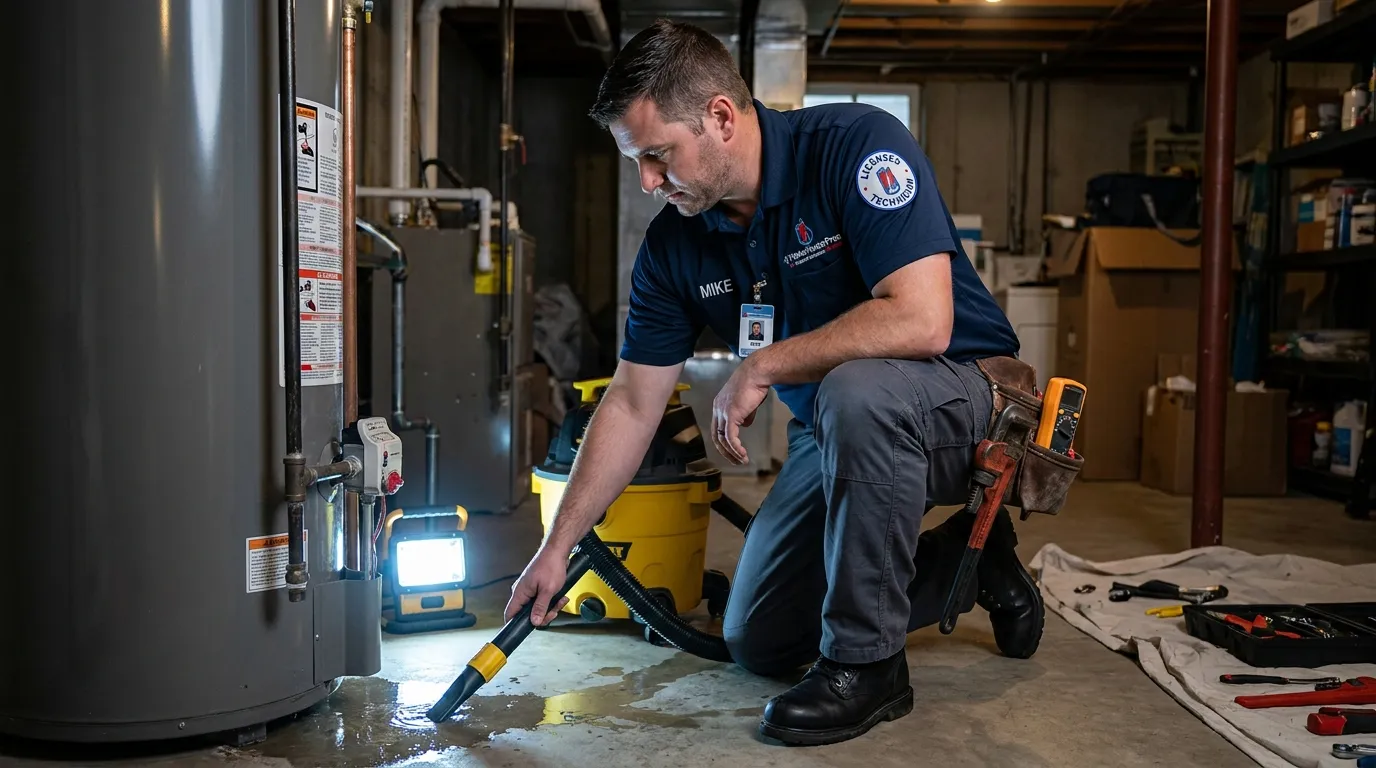
Is Your Lexington Water Heater Problem an Emergency?
If you smell gas near your water heater, evacuate immediately and call 911—then contact your gas company. Do not attempt to locate the source or turn off the unit yourself. If you see active flooding (more than minor pooling), shut off the water supply at the main valve or the cold water inlet above the tank, then call (859) XXX-XXXX for emergency dispatch. For carbon monoxide alarm activation, evacuate and call 911 before addressing any water heater issues.
Immediate Emergency (Call Now)
Gas odor near water heater: Natural gas and propane are odorless; the added "rotten egg" smell indicates a leak. Leave the home immediately without operating light switches, appliances, or garage doors (sparks can ignite gas). Once outside, call 911 and then Columbia Gas of Kentucky at (877) 542-2738. After the gas company clears the scene, call us at (859) XXX-XXXX for repair.
Active flooding: If water is pooling rapidly (more than a few cups), turn off the cold water supply valve at the top of the tank (clockwise) or the main water shutoff where the line enters your home. In Lexington's older homes—common in central 40502 and 40503 ZIP codes—main shutoffs are often in basements near the water meter or in crawlspaces. If you cannot locate the valve or it won't turn, call (859) XXX-XXXX immediately. Our average emergency response time is 35-45 minutes to central Lexington, 50-60 minutes to outer areas like 40511 (north Lexington) and 40509 (southeast).
Carbon monoxide alarm sounding: Evacuate and call 911. CO buildup can result from improper water heater venting—a problem in Lexington's aging housing stock where single-wall vent connectors and missing draft hood spill switches are common. After emergency services clear the home, call (859) XXX-XXXX for venting inspection and repair.
Urgent (Same-Day Service)
No hot water with faint gas smell: If you smell gas but it's faint and localized to the water heater closet, the pilot light is likely out. Ventilate the area, wait 10 minutes, and attempt to relight the pilot following manufacturer instructions only if you're comfortable doing so. If the pilot won't stay lit after 2-3 attempts, or if you're unsure, call (859) XXX-XXXX. The thermocouple (a safety device that shuts off gas when the pilot is out) may have failed—a $150-$180 repair.
Leaking from top connections: Water dripping from the cold water inlet, hot water outlet, or pressure relief valve at the top of the tank often indicates loose fittings or a faulty pressure relief valve—both repairable. Turn off the water supply valve above the tank (clockwise), place a bucket beneath the leak, and call (859) XXX-XXXX for same-day diagnosis. In Lexington, where limestone sediment causes pressure relief valves to calcify and drip after 5-7 years, replacement runs $150-$200.
Popping, rumbling, or banging noises: Loud noises indicate sediment buildup at the tank bottom. Lexington's hard water (10-15 grains per gallon) accelerates sediment accumulation, creating a barrier between the burner and water that reduces efficiency and can cause localized overheating and tank cracking. Schedule a flush within 24 hours to prevent permanent damage. Flushing costs $100-$150; if ignored, tank replacement runs $800-$1,200.
Rusty or discolored hot water: Brown, red, or rust-colored hot water means the anode rod—a sacrificial component that prevents tank corrosion—has depleted, and the tank itself is rusting. In Lexington's limestone water, anode rods typically fail in 2-3 years instead of the national 5-year average. If caught early, anode rod replacement ($150-$200) can extend tank life 3-5 years. If the water remains discolored after running hot taps for several minutes, the tank is likely corroding internally and will need replacement soon.
Scheduled (Next 1-3 Days)
Running out of hot water faster than usual: If showers go cold midway through or the dishwasher doesn't get hot water, you're facing either a capacity issue (undersized tank for household demand) or a failing heating element (electric) or burner (gas). Winter exacerbates this: Lexington's incoming water temperature drops to 38-42°F December through February, reducing effective capacity by 25%. A 40-gallon tank delivers only ~25 gallons of 120°F water when inlet water is 40°F versus 35+ gallons in summer. Diagnosis and component repair typically cost $200-$350; if the tank is undersized, replacement is the long-term solution.
Pilot light goes out frequently: If the pilot extinguishes every few days or weeks, the thermocouple is failing, the gas control valve is malfunctioning, or downdrafts from improper venting are blowing it out. In older Lexington homes (1950-1970 construction common in 40502, 40503, and 40504), venting systems often don't meet current code—single-wall connectors lack clearance, or flues are undersized and shared with furnaces. Thermocouple replacement runs $150-$180; venting upgrades for code compliance cost $200-$500 depending on configuration.
Water heater age 10+ years, no problems yet: Proactive replacement before failure avoids emergency situations during Lexington's coldest weeks (late December through February) when plumbers are swamped with freeze-related calls and after-hours premiums apply. In Lexington's hard water, tank water heaters average 8-10 years; if yours is older and still functioning, schedule replacement at your convenience rather than risk a holiday or winter emergency.
For immediate emergency service, call (859) XXX-XXXX. Our 24/7 dispatch responds to central Lexington (40502, 40503, 40504, 40507) within 35-45 minutes, north and southeast areas (40511, 40509) within 50-60 minutes.
Interactive Tool: Check Your Symptoms
Select your symptom below for immediate guidance and the right next step.
What problem are you experiencing?
Emergency water heater repair in Lexington, Fayette County is available around the clock. If your water heater is leaking, producing no hot water, or making unusual noises, ourKentucky Master Plumber-licensed contractors can be at your door within 30 minutes. Call +1-888-387-1216 now for immediate dispatch to your Lexington address.
Common Water Heater Problems in Lexington Homes
From failing heating elements tripping breakers to corroded anode rods causing rusty water, Lexington's limestone-heavy water plays a direct role in these common failures. Fayette County's water hardness—averaging 10-12 grains per gallon—accelerates sediment accumulation and anode rod depletion at rates 40% faster than the national average, shortening equipment lifespan and requiring more frequent maintenance than homeowners in soft-water regions ever face.
Hard Water Accelerates Anode Rod Corrosion
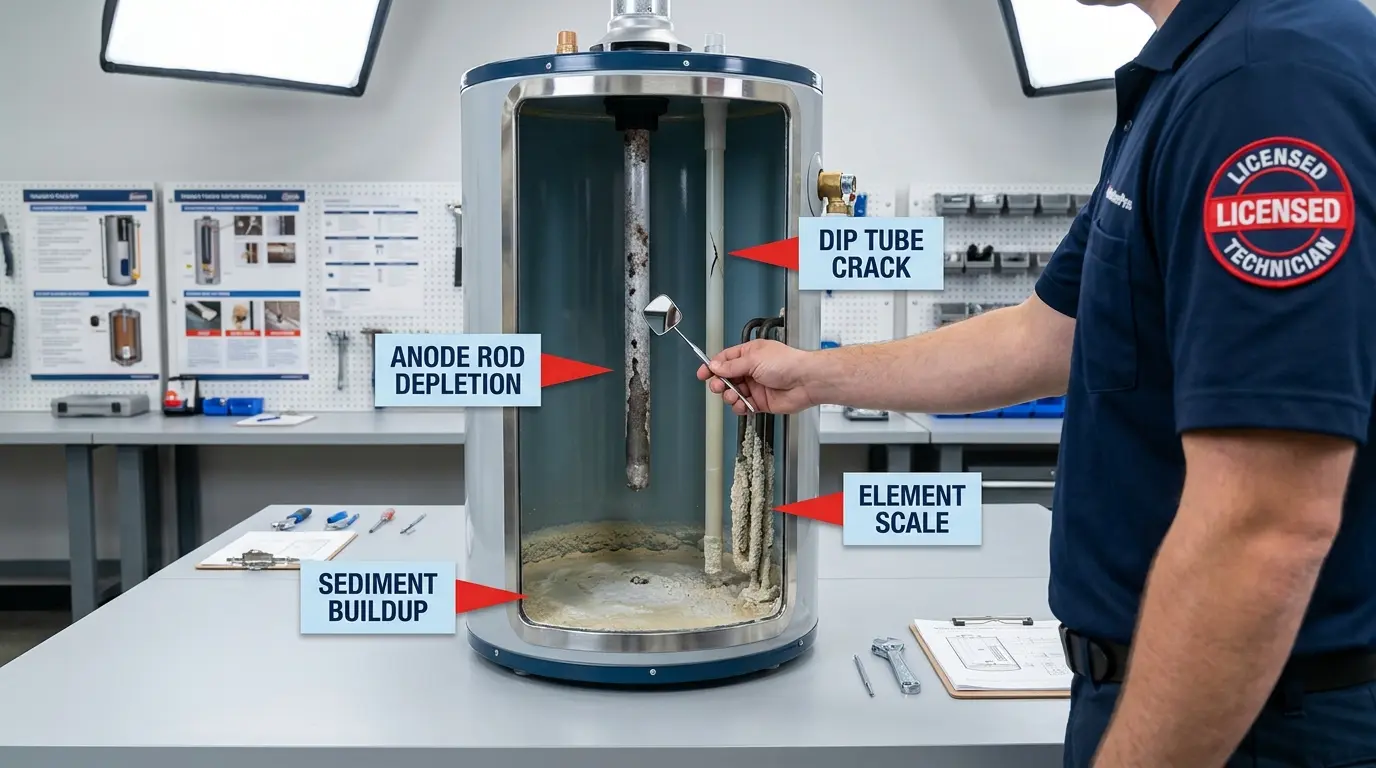
Lexington's limestone aquifer water contains high concentrations of calcium carbonate that precipitate when heated, forming thick scale deposits inside the tank. The sacrificial anode rod—a magnesium or aluminum core wire designed to corrode instead of the steel tank—depletes in 2-3 years in Lexington water conditions compared to the manufacturer's 5-6 year estimate for average water. Once the anode rod is consumed, the tank's steel lining begins rusting, causing rust-colored hot water and eventually tank perforation.
Homeowners in central Lexington ZIP codes 40502 and 40503 report rusty water appearing 8-10 years into a water heater's life, signaling the anode rod failed years earlier without inspection. By the time discoloration is visible, internal corrosion is usually advanced enough that replacement makes more sense than attempting a late-stage anode rod swap. Proactive anode rod inspection and replacement every 2-3 years extends tank life by preventing this cascade, but most Lexington homeowners never open the top of their water heater until a problem forces it.
Sediment Buildup Causes Popping Sounds and Efficiency Loss
Popping sounds like popcorn? That's sediment baking on the burner. Lexington's hard water leaves behind mineral deposits that settle to the tank bottom, forming a thick insulating layer between the burner and the water. As the burner fires, steam bubbles form under the sediment crust and violently escape, creating the characteristic rumbling, popping, or banging noises that wake homeowners at night.
This sediment layer forces the burner to work harder and longer to heat water through the mineral barrier, reducing efficiency by 20-30% and increasing gas bills. Sediment also traps moisture against the tank floor, accelerating corrosion at the base where leaks most commonly develop. Annual tank flushing removes sediment before buildup becomes severe, but the process is rarely performed until the noise becomes unbearable or the unit fails inspection during a home sale.
Homes in southeast Lexington's 40509 ZIP code—many built 1990s-2000s with builder-grade water heaters—frequently experience sediment failures at 7-9 years when the original unit has never been flushed. At this point, the sediment is often too compacted to fully drain, and attempting a flush can dislodge chunks that clog the drain valve permanently open, forcing immediate replacement.
Aging Housing Stock and Non-Compliant Venting Systems
Lexington's 1950-1970 housing stock in neighborhoods throughout the 40505 and 40511 ZIP codes commonly features original or first-replacement water heaters installed when building codes were less stringent. Single-wall vent connectors—thin metal pipes connecting the water heater to the chimney—were standard until the mid-2000s but corrode quickly from combustion gases, creating fire and carbon monoxide risks. Modern code requires double-wall Type B venting for all new installations, triggering a $200-$400 upgrade cost when replacing a water heater in these older homes.
Many older homes also have undersized flues shared between the furnace and water heater. When both appliances vent into the same chimney, improper draft can cause combustion gases to spill into the living space rather than exhausting outdoors. Draft hood spill switches—safety devices that shut down the water heater if venting fails—are absent on units installed before 2006, leaving homeowners unaware of dangerous backdrafting conditions until someone gets sick or a home inspector flags the issue.
Homes with atmospheric vent water heaters in basements or utility rooms without adequate combustion air openings also experience incomplete combustion and sooting. Kentucky code requires two permanent openings—one within 12 inches of the ceiling and one within 12 inches of the floor—each with at least one square inch of free area per 1,000 BTU of combined appliance input. Older homes routinely lack these openings, and adding them during water heater replacement adds $150-$300 to the project when cutting exterior louvers or installing air ducts is necessary.
Winter Cold Reduces Effective Capacity and Creates Freeze Risk
Kentucky winters drop incoming water temperature from a summer high of 60°F to 38-42°F in January and February. A 40-gallon water heater must work significantly harder to raise 38°F water to 120°F than it does heating 60°F water, effectively reducing capacity by 25%. Families accustomed to back-to-back showers suddenly run out of hot water mid-shower when the cold snap hits, mistaking the capacity loss for a failing heating element.
Water heaters installed in unheated garages or crawlspaces—common in north Lexington's 40511 ZIP code—face freeze risk when temperatures drop below 32°F for extended periods. Pressure relief valve discharge pipes, which terminate near the floor, freeze solid and split, causing flooding when they thaw. Cold water supply lines freeze and burst inside walls or beneath the water heater platform. Emergency plumbers across Lexington see a surge in burst pipe calls every January as arctic fronts settle over Fayette County.
Homeowners can wrap exposed pipes with foam insulation and open cabinet doors to allow warmer air circulation during extreme cold, but water heaters in consistently cold locations benefit most from relocation to conditioned space during replacement. Moving a water heater from an unheated garage to a basement mechanical room adds $400-$800 to replacement cost but eliminates freeze risk and improves efficiency year-round.
Electrical System Limitations in Pre-1990 Homes
Tankless water heater conversions in Lexington's older housing stock frequently require electrical panel upgrades. Gas tankless units need a dedicated 15-20 amp circuit for electronic controls and ignition, which many homes built before 1990 lack. Electric tankless heaters demand 100-150 amps of electrical service—often requiring a complete panel upgrade from the 100-amp service common in pre-1980 construction—adding $1,500-$3,000 to the installation cost before the water heater itself is even purchased.
Even tank water heater replacements sometimes trigger electrical work. Modern power vent water heaters require a standard 120V outlet within six feet of the unit, and many older utility rooms lack dedicated outlets. Running a new circuit from the electrical panel to the water heater location adds $200-$400 to the replacement quote, catching homeowners off guard when they assumed a simple swap would suffice.
Understanding these Lexington-specific challenges helps homeowners recognize when a water heater issue requires immediate professional attention versus scheduled maintenance, and why replacement costs sometimes exceed simple equipment swap expectations when code compliance upgrades are legally required.
Comprehensive Water Heater Solutions
From emergency repair to tankless upgrades, our licensed contractors handle every water heater need in Lexington with code-compliant, warranty-backed work.
Installation
Expert sizing and installation of standard gas and electric water heaters with all permits included.
Learn More arrow_forwardRepair
Fast, reliable diagnostics and repair for leaks, no hot water, and pilot issues.
Learn More arrow_forwardTankless
High-efficiency tankless upgrades for endless hot water and space savings.
Learn More arrow_forwardMaintenance
Annual flushing and anode rod inspections to extend heater lifespan.
Learn More arrow_forward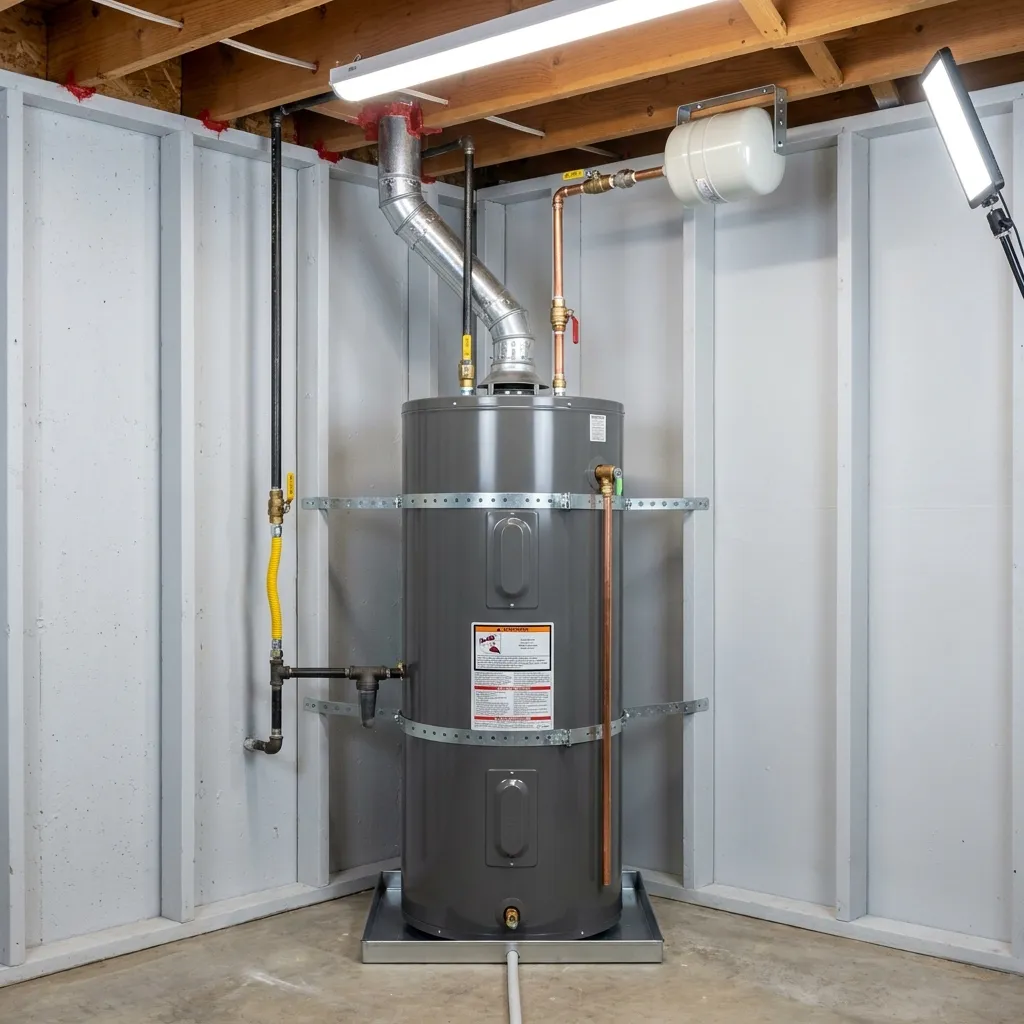
Tank Water Heater Services in Lexington
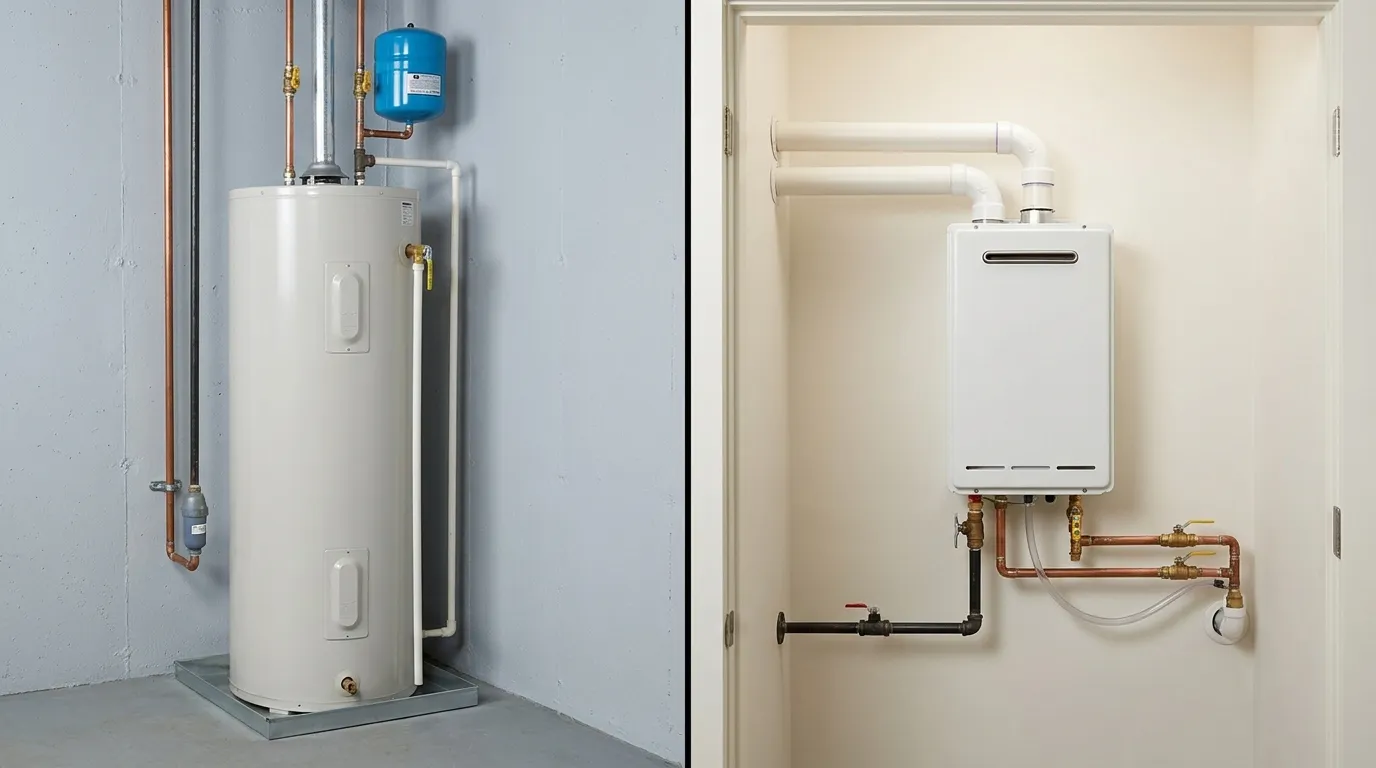
For most Lexington homes, a 40 or 50-gallon tank water heater offers the lowest upfront cost and simplest repair path, especially for homes with 1/2-inch gas lines or 100-amp electrical panels. Tank water heaters remain the workhorse of Fayette County basements and garages—handling Lexington's variable well water pressure better than tankless units, requiring no electrical panel upgrades, and working with the existing gas infrastructure in homes built before 1990. For homeowners facing replacement decisions, understanding how tank size, venting type, and local water chemistry affect performance determines whether you'll spend $900 or $2,200 on the same installation.
Choosing the Right Tank Size for Lexington Households
A 40-gallon tank serves 1-2 people adequately when incoming water temperature stays above 55°F. In Lexington's winter months, when incoming water drops to 38-42°F, that same 40-gallon unit delivers only 25 gallons of usable 120°F water—barely enough for one shower and a load of dishes. Families of 3-4 need a 50-gallon minimum to maintain hot water availability during December through February cold snaps. Homes with 5+ occupants, soaking tubs, or high-demand appliances require 75-gallon tanks or consideration of tankless alternatives.
The 50-gallon size handles Lexington's winter temperature swings without forcing families to stagger showers. It costs $100-$200 more than a 40-gallon at installation but eliminates the frustration of running out mid-shower when your teenager used the hot water first. For older homes in central Lexington's 40502 and 40503 ZIP codes where basement ceiling height allows, 50-gallon atmospheric vent models fit existing infrastructure without requiring expensive venting modifications.
Atmospheric Vent vs. Power Vent: What Lexington Homes Need
Atmospheric vent tank water heaters rely on natural draft—hot exhaust rises through a vertical metal flue that connects to your chimney or exits through the roof. These work in homes with existing masonry chimneys and adequate combustion air, common in Lexington's pre-1980 housing stock. They cost $800-$1,200 installed for a 40-50 gallon unit and require no electrical connection beyond the gas valve's thermocouple circuit.
Power vent models use an electric blower to force exhaust through PVC or stainless steel pipe that can vent horizontally through an exterior wall. Lexington homes without chimneys, homes where the chimney is too small or deteriorated, or installations in interior closets without vertical flue access require power vent models. They cost $1,500-$2,200 installed due to the more complex venting and the unit's higher base price. The electric blower adds a potential failure point but eliminates backdraft risks when negative air pressure develops from bathroom exhaust fans or whole-house ventilation systems.
During replacement in homes built before 1970, contractors often discover undersized shared flues—a single chimney handling both the furnace and water heater—that violate current code. Power vent conversion solves this by eliminating the chimney dependency, but the $700-$900 cost premium over atmospheric must be weighed against the alternative: relining or rebuilding the chimney flue, which runs $2,000-$4,000.
Gas vs. Electric: Infrastructure Determines Your Choice
Gas tank water heaters heat water faster and cost less to operate in Lexington where natural gas rates average $1.20-$1.40 per therm. A 50-gallon gas unit costs $900-$1,400 installed if your home has an existing 1/2-inch gas line to the water heater location and compliant venting. Recovery time—how fast the tank reheats after heavy use—runs 45-60 minutes for gas versus 90-120 minutes for electric, meaning families notice less disruption.
Electric tank water heaters require no venting and no gas line, making them the default choice for homes without gas service or where gas line routing is cost-prohibitive. Installation costs $800-$1,200 for a 50-gallon electric unit. They require a dedicated 30-amp 240V circuit—standard in most Lexington homes built after 1960. Operating costs run $400-$500 annually versus $250-$300 for gas at current utility rates, adding $150/year to lifetime ownership cost.
For Lexington homes on propane in outer Fayette County areas, electric tank water heaters often prove more economical than propane despite higher electricity costs, because propane prices fluctuate $2.50-$4.00 per gallon and delivery logistics complicate fuel management.
Expansion Tank Requirements in Lexington
Lexington adopted the 2006 International Plumbing Code requirement that closed plumbing systems—those with backflow preventers or check valves on the main water supply—must have thermal expansion tanks. Most Lexington homes installed after 2006 include backflow preventers at the meter, making expansion tanks mandatory during water heater replacement even if the old system lacked one.
Without an expansion tank, thermal expansion when water heats creates pressure spikes that stress pipe joints, trigger pressure relief valve dripping, and shorten water heater lifespan. The expansion tank absorbs this pressure increase through an internal air bladder. Installation adds $150-$200 to replacement cost but prevents $300-$500 pressure relief valve replacements and potential flooding when valves fail open.
Component Repairs That Extend Tank Lifespan
Gas valve replacement addresses pilot light failures, weak flames, or units that won't stay lit. In Lexington's limestone water, sediment can clog the gas valve's pilot orifice or thermocouple tip, causing nuisance shutdowns. Gas valve replacement costs $300-$400 and often restores reliable operation for tanks under 8 years old where the tank itself shows no corrosion.
Anode rod replacement every 2-3 years in Lexington's hard water extends tank life from 8-10 years to 12-15 years by preventing the tank steel from corroding. The sacrificial magnesium or aluminum rod corrodes instead of the tank. Once the anode rod depletes completely, rust-through begins within 12-18 months. Anode rod inspection and replacement costs $150-$200 and should occur during annual maintenance flushing.
Heating element failure in electric tanks causes no hot water (if the lower element fails) or insufficient hot water (if the upper element fails). Element replacement costs $200-$350 depending on element accessibility and whether sediment must be cleared before installation. Tanks with heavy sediment buildup may not be worth element replacement if the lower element is buried in scale—flushing becomes impossible and replacement makes more economic sense.
Pressure relief valve replacement addresses constant dripping or leaking from the TPRV. These valves open at 150 PSI or 210°F to prevent tank rupture. In Lexington homes without expansion tanks, thermal expansion pressure causes nuisance TPRV dripping. Valve replacement costs $150-$200 but won't solve the underlying pressure issue—expansion tank installation is required for a permanent fix.
Maintenance Schedules for Lexington Water Chemistry
Annual tank flushing removes sediment that accumulates from Lexington's calcium carbonate-heavy water. Sediment insulates the heating surface, forcing the burner or elements to run longer to heat the water. This wastes energy and accelerates component failure. Tanks that go unflushed for 3+ years develop sediment layers 2-4 inches thick that restrict drain valve operation, making flushing nearly impossible without professional hydro-jetting equipment.
Anode rod inspection every 2 years and replacement every 3 years protects the tank in Lexington water conditions. Waiting until the anode rod depletes completely before replacement allows tank corrosion to begin, which cannot be reversed. The $150 anode rod replacement at year 3 and year 6 adds $300 to lifetime cost but can double tank lifespan from 8 to 16 years—a $900-$1,200 replacement deferred for nearly a decade.
Pressure relief valve testing annually ensures the safety mechanism works. Lift the TPRV lever briefly to confirm water discharges, then release to verify it reseats and stops flowing. If the valve doesn't discharge or continues leaking after testing, replacement is required before the valve fails completely during an overpressure event.
Call (859) XXX-XXXX for a tank water heater replacement quote or to schedule maintenance service. Licensed contractors serving all 39 Lexington ZIP codes can assess your current tank, recommend the right size and venting type for your home's infrastructure, and complete installation with next-business-day inspection scheduling through the Lexington-Fayette Urban County Government permit office.
Tankless Water Heater Services in Lexington
Tankless water heaters provide endless hot water and last 20+ years, but they require expensive gas line or electrical upgrades in many older Lexington homes. Before you commit to the $2,500-$3,500 installed cost, you need to understand whether your home's infrastructure can support the 180,000+ BTU gas demand or 150+ amp electrical load—and whether the upfront investment makes financial sense given Lexington's $1.12/therm natural gas rates and limestone water chemistry that demands annual descaling maintenance.
When Tankless Makes Sense for Lexington Homes
Tankless water heaters excel in Lexington homes with high hot water demand—families of 4+ running simultaneous showers, dishwashers, and laundry cycles. The space-saving wall-mounted design appeals to homeowners in central Lexington's 40502 and 40503 ZIP codes who are converting basements to finished living areas or adding bathrooms. For long-term homeowners planning to stay 10+ years, the 20-25 year lifespan delivers value that a 10-12 year tank unit cannot match.
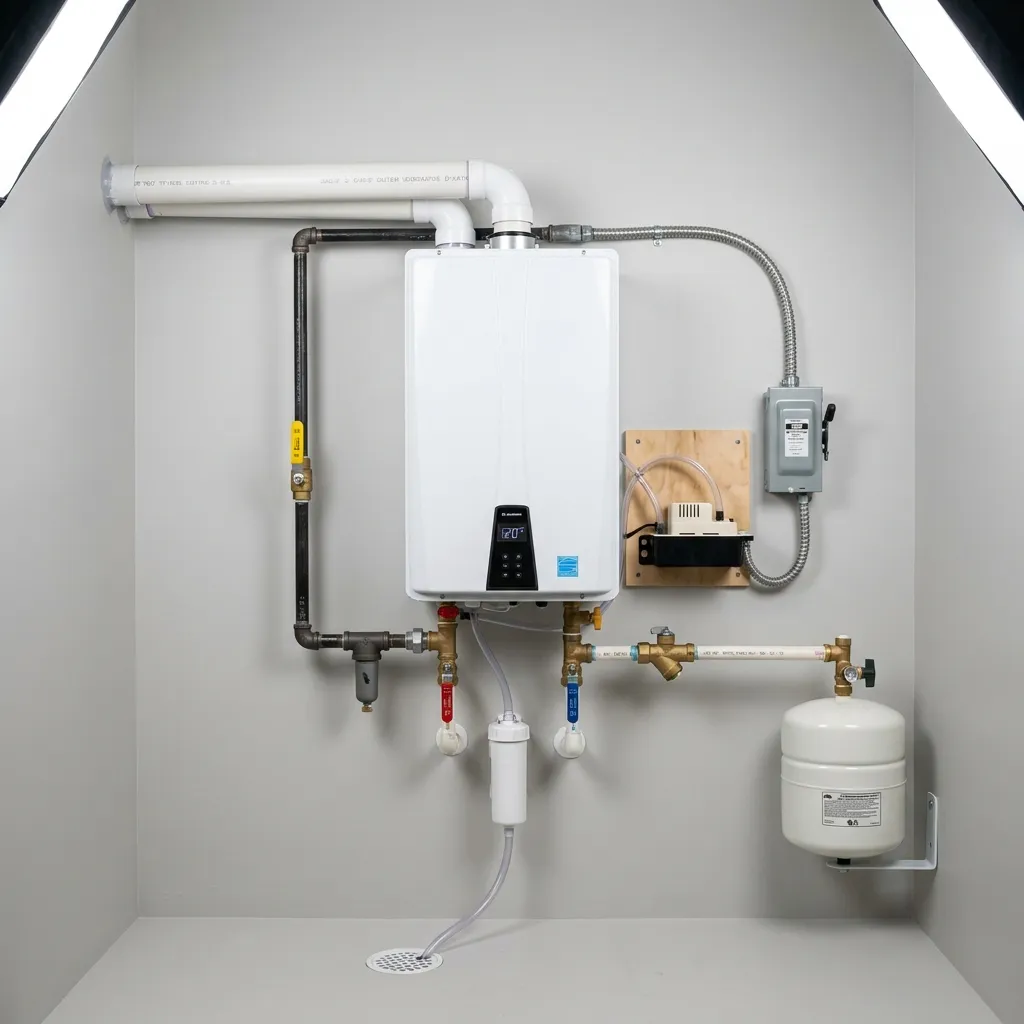
But tankless units demand infrastructure that many Lexington homes—especially those built 1950-1990—simply don't have. A whole-house gas tankless unit requires 180,000-200,000 BTU capacity, far exceeding the 40,000 BTU demand of a standard tank water heater. Most homes in Fayette County have 1/2-inch gas lines sized for tank water heaters; tankless installation requires upgrading to 3/4-inch lines from the meter to the unit, adding $800-$1,500 to the project cost.
Electric tankless units sidestep gas line upgrades but create electrical demands even more challenging for older Lexington homes. A whole-house electric tankless requires 100-150 amps on a dedicated 240V circuit. Homes built before 1990 typically have 100-amp service panels already near capacity with HVAC, kitchen appliances, and dryers. Panel upgrades to 200-amp service cost $1,800-$3,200 in Lexington—often more than the tankless unit itself.
Gas Line and Venting Requirements
Gas tankless units burn hotter and more efficiently than atmospheric tank water heaters, producing acidic condensate that corrodes traditional metal venting. Condensing tankless models (the most efficient) require PVC or CPVC vent piping, while non-condensing units need stainless steel Category III venting. Neither can share a vent with a furnace—a common configuration in older Lexington homes where the water heater and furnace both connect to a shared chimney flue.
For homes in north Lexington's 40511 ZIP code with basements, running new dedicated venting through foundation walls or rim joists adds $400-$800 to installation costs. Homes in southeast Lexington's 40509 area with water heaters in unheated garages face freeze protection challenges; tankless units installed in spaces that drop below 40°F require insulated enclosures or heated recirculation systems to prevent damage during Lexington's winter cold snaps when temperatures fall to 10-15°F.
The gas line pressure test becomes critical before any tankless installation. Lexington contractors measure static and dynamic pressure at the proposed installation location to verify adequate supply. Insufficient pressure—common in homes at the end of long gas line runs—causes the unit to cycle on and off, delivering the dreaded "cold water sandwich" effect where hot water is interrupted by bursts of cold water mid-shower.
Point-of-Use vs. Whole-House Applications
Point-of-use tankless units offer a compromise for Lexington homeowners who want endless hot water at specific fixtures without whole-house infrastructure upgrades. Installing a small electric tankless (8-12 KW) under a bathroom sink or near a remote shower requires only a 40-50 amp 240V circuit—manageable in most homes without panel upgrades.
This approach works well for Lexington homes where the water heater sits in a basement or garage 40+ feet from a master bathroom added during renovation. Rather than waiting 45-60 seconds for hot water to travel through pipes, a point-of-use tankless delivers instant hot water while the existing tank water heater serves the rest of the house. Installation costs run $800-$1,400 including electrical work—far less than a whole-house tankless conversion.
But point-of-use units cannot support high-demand fixtures. An 8 KW unit delivers 1.5-2.0 gallons per minute at Lexington's 40-degree winter incoming water temperature—enough for a single low-flow showerhead (1.5 GPM) but insufficient for a standard 2.5 GPM shower or simultaneous sink use. Homeowners who expect tankless performance across multiple fixtures need whole-house capacity.
The Cold Water Reality in Lexington
Tankless sizing calculators assume 50-60°F incoming water temperature, but Lexington's winter reality is harsher. From December through February, groundwater temperatures in Fayette County drop to 38-42°F. A tankless unit rated for 9 GPM flow at a 77-degree temperature rise (50°F incoming to 127°F output) only delivers 5-6 GPM when incoming water is 40°F.
For a Lexington family running two showers (3.0 GPM total) plus a dishwasher (1.5 GPM) simultaneously on a January morning, that 9 GPM-rated unit cannot keep up. Flow drops below demand, triggering temperature fluctuations and cold water sandwiches. Properly sizing for Lexington's winter conditions means specifying a unit 30-40% larger than the standard calculator suggests—and paying proportionally more for both equipment and gas line capacity.
Maintenance: Annual Descaling is Not Optional
Lexington's 10-12 grains per gallon water hardness causes calcium carbonate scale to accumulate inside tankless heat exchangers, restricting water flow and reducing efficiency. Manufacturers specify annual descaling with citric acid or vinegar solutions circulated through the unit for 45-60 minutes. Skip this maintenance, and the heat exchanger clogs within 3-5 years, requiring $800-$1,200 replacement—often more than half the cost of a new unit.
DIY descaling is possible but requires purchasing a descaling kit ($150-$200) and following precise procedures to avoid damaging internal components. Most Lexington homeowners opt for professional annual maintenance ($150-$200), adding ongoing costs that tank water heaters don't require. Over a 20-year lifespan, that's $3,000-$4,000 in maintenance you wouldn't pay with a tank unit.
Repair Costs and Complexity
When tankless units fail, repairs cost more than tank water heater fixes. Flow sensors ($200-$300 replacement), ignition modules ($250-$400), and circuit boards ($300-$500) are common failure points. Heat exchanger scaling severe enough to cause permanent damage runs $800-$1,200 to replace. In contrast, Lexington's average tank water heater repair—a thermostat, heating element, or pressure relief valve—costs $180-$350.
Tankless units also require specialized diagnostic equipment and training. Not every plumber in Fayette County services all tankless brands, potentially limiting your options during an emergency. Parts availability matters too; ordering a proprietary circuit board for a less common brand can take 3-5 business days, leaving your family without hot water longer than the same-day turnaround typical for standard tank components.
Energy Savings and ROI in Lexington
At Lexington's $1.12/therm natural gas rate, a gas tankless unit saves approximately $120-$180 per year compared to a standard 50-gallon tank water heater operating at 0.60 Energy Factor. That's $2,400-$3,600 in savings over 20 years—offset by higher installation costs ($1,500-$2,000 more than tank), required infrastructure upgrades ($800-$3,500), and annual maintenance ($3,000-$4,000 over 20 years).
Simple ROI calculation: If you're replacing a 10-year-old tank water heater, spending $3,200 on tankless vs. $1,100 on a new tank, adding $1,200 for gas line upgrades and $150/year maintenance, you're investing $6,500 over 20 years to save $3,000 in energy costs. The financial case only works if you value the endless hot water convenience and space savings enough to accept a 15+ year payback period.
For homeowners planning to sell within 5-10 years, tankless rarely makes financial sense in Lexington's market. Buyers don't typically pay $2,000-$3,000 more for a home with tankless vs. a new tank water heater, and you won't recover the installation premium.
Outdoor Installation and Freeze Protection
Condensing tankless units designed for outdoor installation eliminate venting concerns but introduce freeze protection challenges in Lexington's climate. Units rated for outdoor use in freezing temperatures typically include built-in freeze protection that circulates water when ambient temperature drops below 35°F—but this protection only works if the unit has power and adequate gas pressure.
During extended power outages common in Fayette County during ice storms, outdoor tankless units risk freeze damage to internal components. Installing a battery backup system ($400-$800) mitigates this risk but adds cost and complexity. Most Lexington contractors recommend indoor installation with proper venting for climate-related reliability.
Recirculation Systems for Instant Hot Water
One of tankless water heating's selling points—instant hot water—is actually a myth without a recirculation system. A tankless unit installed in a Lexington basement 50 feet from the master bathroom still requires 45-60 seconds for hot water to travel through supply pipes, just like a tank water heater.
Adding a recirculation pump and return line ($800-$1,500 installed) or a tankless-compatible recirculation system with a crossover valve at the furthest fixture ($600-$1,000) delivers true instant hot water. But recirculation systems consume energy by continuously cycling hot water through pipes or operating on temperature-based timers. That energy consumption—$50-$100 per year—reduces the efficiency gains that tankless units promise.
Call (859) XXX-XXXX to discuss whether tankless water heating fits your Lexington home's infrastructure and budget.
Tank or Tankless: What's Right for Your Lexington Home?
Answer 7 questions for a personalized recommendation based on your home, budget, and hot water needs.
Question 1 of 7 — Budget (25% weight)
What's your budget range for a new water heater?
Considering a tankless water heater upgrade for your Lexington home? Our licensed contractors in Fayette County help you evaluate whether tank or tankless is the right fit based on your household size, gas line capacity, and local water conditions. Every estimate includes a free written quote with no obligation. Call +1-888-387-1216 to schedule your assessment.
24/7 Emergency Services in Lexington
Emergency Water Heater Services in Lexington
If you have no hot water, a burst tank, or a gas leak in Lexington, our 24-hour emergency team can arrive within 15-30 minutes to central ZIP codes like 40502 and 40503, or 30-45 minutes to outer areas including 40509 and 40511, to stop the damage and restore safety. We dispatch immediately when you call—no waiting for callbacks or next-day scheduling during water heater crises that flood basements, leave families without hot water in 38°F winter weather, or create carbon monoxide risks from failed venting systems.
What Qualifies as a Water Heater Emergency
Active flooding from a burst tank or ruptured pressure relief valve requires immediate response. We shut off the water supply, contain the flooding, assess structural damage, and begin same-visit replacement if your tank has failed. Gas odor near your water heater means you evacuate the home, call 911, and contact your gas company before calling us—never attempt to locate a gas leak yourself. Once the gas company clears the home, we diagnose the gas valve, thermocouple, or burner assembly failure and restore safe operation.
Carbon monoxide detector activation linked to your water heater demands evacuation and 911 contact first. After emergency services clear the scene, we inspect venting systems—common failures in Lexington's 1950-1970 homes include deteriorated single-wall vent connectors, blocked flues, and backdrafting from insufficient combustion air. We stop the leak, disconnect power or gas if needed, and restore safe venting before returning the unit to service.
No hot water during Lexington's January cold snaps—when incoming water drops to 38-42°F—creates hardship for families who cannot bathe, wash dishes, or do laundry. We diagnose pilot light failures, tripped breakers, failed heating elements, or thermostat malfunctions and restore hot water the same day, often within hours of your call.
Response Times Across Fayette County
Central Lexington service calls in ZIP codes 40502, 40503, 40504, 40505, and 40507 receive 15-30 minute response during business hours, extending to 30-45 minutes after 6pm or weekends when traffic clears. Southeast Lexington areas including 40509 and 40515 average 25-35 minutes during the day, while north Lexington zones like 40511 and 40514 see 20-40 minute arrivals depending on New Circle Road congestion at Richmond Road, Nicholasville Road, or Harrodsburg Road at-grade intersections during rush hour.
We stock service vehicles with 40 and 50-gallon tanks, common repair components (thermostats, heating elements, gas valves, thermocouples, pressure relief valves, anode rods), and tools to handle gas line work, electrical connections, and venting repairs. When same-visit replacement makes sense—your tank is leaking from the bottom, rust-through has occurred, or you're facing a $400 repair on a 12-year-old unit—we complete the installation that day or evening, pull the permit through Lexington's SmartGov portal, and schedule the next-business-day inspection.
After-Hours Emergency Service Costs
Standard emergency service rates apply during business hours (8am-5pm Monday-Friday): $125 diagnostic fee waived if we complete the repair, plus parts and labor. Component repairs range from $180-$250 for thermostat replacement, $200-$350 for heating element work, $300-$400 for gas valve replacement, and $150-$200 for pressure relief valve installation.
After-hours emergency calls—nights, weekends, and holidays—add a $150-$200 premium to the base service charge, reflecting immediate dispatch and technician availability when most contractors are closed. Emergency tank replacements start at $1,200-$1,500 for a standard 40-50 gallon atmospheric vent unit installed after hours, compared to $900-$1,200 during scheduled business-hour appointments.
Safety Protocols We Follow
We verify gas shutoff at the appliance valve and main meter before beginning any gas water heater emergency repair. For electric units, we confirm circuit breaker shutoff and test for voltage at the unit before opening electrical panels or replacing heating elements. We contain flooding with extraction equipment, check for electrical hazards in standing water, and document damage for insurance claims when burst tanks flood finished basements.
Venting inspection follows every emergency repair on gas water heaters. We check draft hood operation, inspect vent connector joints for gaps or corrosion, verify proper slope on horizontal runs, and test for spillage at the draft hood after restoring gas service. Carbon monoxide detectors must be present and functional before we restore any gas appliance to operation—if you don't have one, we install a plug-in CO detector as part of emergency service.
Call (859) XXX-XXXX now for 24-hour emergency water heater service in Lexington. We answer emergency calls day and night, dispatch immediately, and arrive with parts and equipment to stop the problem and restore hot water the same visit.
Water Heater Installation in Lexington
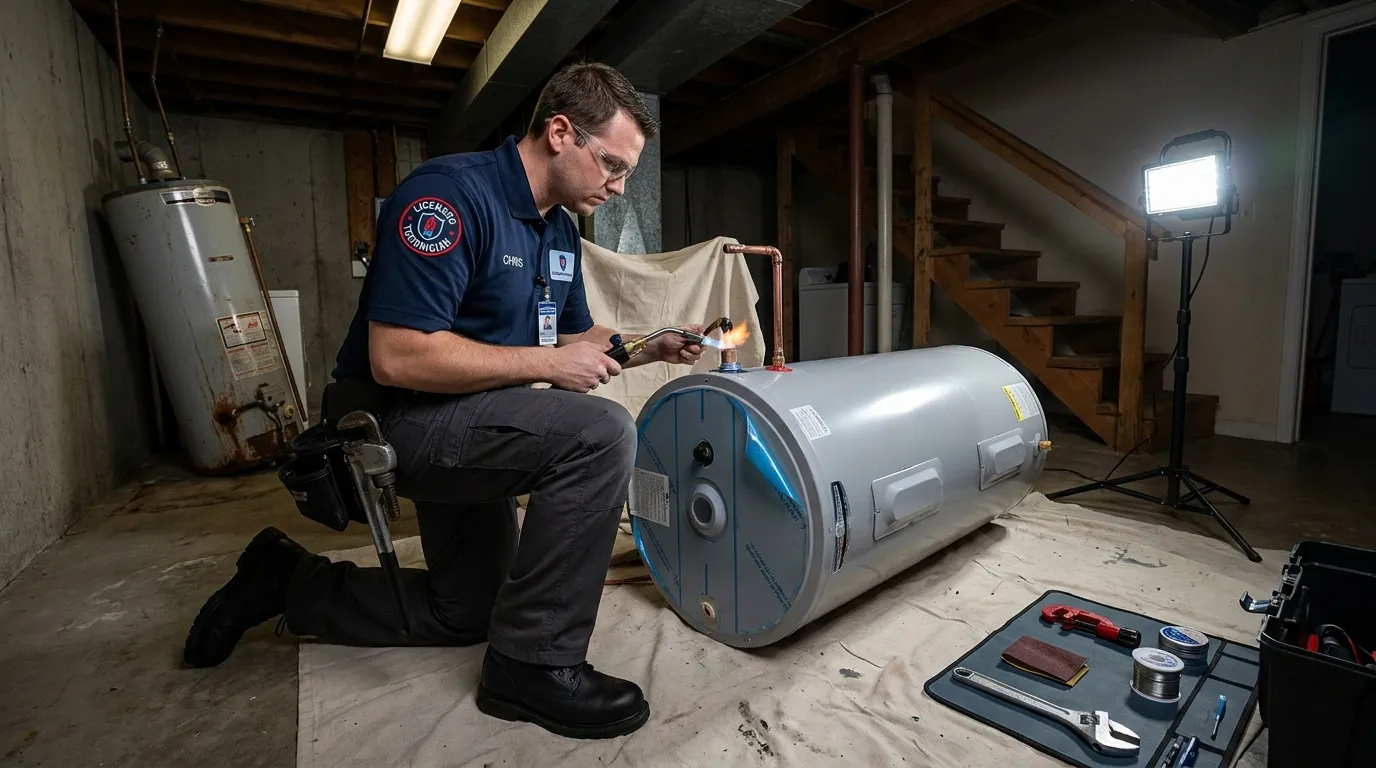
Most standard tank replacements in Lexington take 2-4 hours, but you should budget a full morning to account for Fayette County permit pickup, gas line testing, and code upgrades like expansion tanks and TPRV discharge piping that Kentucky regulations trigger on every replacement—even when the old unit was installed decades before those requirements existed.
The old tank comes out. The new code-compliant piping goes in. Your installer tests the gas valve, verifies combustion air clearances, and schedules the county inspection—all steps that separate legitimate licensed work from the unlicensed shortcuts that leave homeowners facing failed inspections and voided warranties.
Permit Requirements in Fayette County
Lexington-Fayette Urban County Government requires plumbing permits for all water heater replacements and new installations. You'll obtain the permit through the LFUCG SmartGov online portal or by contacting a plumbing inspector directly at (859) 899-5244. Your contractor should handle this—if they suggest skipping the permit "to save money," that's the signal to find a different contractor. Unpermitted work means no inspection, no code compliance verification, and potential liability if something goes wrong.
Permit costs vary by project scope but typically run $50-$100 for standard residential tank replacements. The inspection usually happens the next business day after installation, with the inspector verifying gas connections, venting clearances, pressure relief valve discharge piping, and expansion tank installation. Plan for the inspector to need access to the installation area—clear a path and make sure someone's home during the scheduled window.
Code Compliance Upgrades You'll Pay For
Every water heater replacement in Lexington triggers Kentucky code requirements that didn't exist when your 1970s or 1980s unit was installed. These aren't optional upgrades your contractor is upselling—they're mandatory compliance items the inspector will flag if they're missing.
Expansion tank ($150-$200 installed): Required for closed plumbing systems, which includes nearly every home in Lexington. The expansion tank absorbs pressure increases when water heats and expands, preventing pressure relief valve leaks and premature tank failure. Your old water heater might not have one—your new installation must.
TPRV discharge piping ($75-$150): The temperature and pressure relief valve discharge pipe must terminate within 6 inches of the floor and drain to an approved location—not into the tank's drain pan, not aimed at a wall. Older installations often violate this, creating scalding hazards if the valve activates.
Double-wall vent connector ($100-$200): Single-wall vent pipe connectors, common in pre-2006 installations across central Lexington's 40502 and 40503 ZIP codes, no longer meet code. The replacement requires double-wall B-vent connector from the draft hood to the chimney or power vent termination.
Earthquake straps ($50-$75): Not universally required in Kentucky, but some jurisdictions and insurance companies mandate them. Your contractor will know local requirements.
Drain pan ($100-$150): If the water heater sits in an attic, second floor, or anywhere a leak would damage finished space below, a drain pan with a termination line to an approved drain prevents thousands in water damage. Many Lexington homes with garage or basement installations won't need this, but upstairs closet units require it.
Gas Line Pressure Testing and Sizing
Before your new water heater fires up, your installer tests the gas supply line for leaks at operating pressure. This isn't optional—it's a code requirement and a safety necessity. If your existing 1/2-inch gas line adequately supplied your old 40,000 BTU water heater, it will still work for a similar replacement. But if you're upgrading to a 50-gallon power vent unit (50,000 BTU) or a tankless system (180,000+ BTU), you'll need gas line sizing calculations and potentially a line upgrade from 1/2-inch to 3/4-inch—adding $500-$1,200 to your project.
Lexington's older homes, particularly those built before 1980 in central neighborhoods, often have undersized gas lines that served smaller appliances. Your contractor measures gas pressure at the water heater with all other gas appliances running (furnace, stove, dryer) to verify adequate supply. Low pressure readings mean you'll need a line upgrade before the new water heater can operate safely.
Old Unit Disposal
Your contractor removes the old water heater and disposes of it properly—that's included in standard replacement quotes at $25-$50. Fayette County's solid waste facilities accept old water heaters, but most contractors use scrap metal recycling to offset disposal costs. If you're attempting DIY removal, know that a 40-gallon tank filled with sediment can weigh 150+ pounds and requires two people to move safely. The drain valve at the bottom empties the tank, but you'll still face a heavy, awkward lift through doorways and down stairs.
Preparation Steps Before Installation Day
Clear a path from your driveway or street to the water heater location. Contractors arrive with hand trucks and new equipment—tight corners, narrow basement stairs, and cluttered garages slow the job and can increase labor charges if access problems weren't disclosed upfront. Move vehicles out of the garage if that's where the water heater sits. Make sure pets are secured away from the work area.
If your water heater is in a closet, empty the closet. If it's behind stored boxes in a basement corner, clear the area before the crew arrives. Combustion air clearance requirements mean contractors need 18-24 inches of working space around the unit—both for installation and for future maintenance access.
Verify someone will be home for the inspector the next day. The inspection takes 15-30 minutes, but the inspector needs interior access and may need to test gas connections or verify venting clearances. Missing an inspection appointment delays your sign-off and can trigger rescheduling fees.
What Happens on Installation Day
The crew arrives, confirms the new unit matches your order (size, venting type, fuel type), and begins removal of the old water heater. They'll shut off gas and water supplies, drain the old tank, disconnect gas and water lines, and remove the old unit. For tank-to-tank replacements in typical Lexington homes, this takes 30-45 minutes.
New unit installation involves positioning the tank, connecting the cold water inlet and hot water outlet with new flex lines or copper pipe, installing the gas line connection, connecting the vent pipe to the existing flue or power vent termination, and installing code-required components like the expansion tank and TPRV discharge piping. The installer tests all connections for leaks, lights the pilot or activates the electronic ignition, adjusts the thermostat to 120°F, and verifies proper combustion and venting.
Gas line leak testing happens under pressure with all connections exposed. Your installer uses soapy water or electronic leak detectors at every threaded connection from the gas valve back to the supply line shutoff. A single leak fails the installation and requires immediate correction before the gas can stay on.
Final steps include filling the tank, purging air from the hot water lines, verifying temperature rise, and walking you through the new unit's operation—where the gas shutoff is, how to relight the pilot if needed, when to test the pressure relief valve, and what maintenance schedule to follow given Lexington's hard water.
Inspection Timeline
Your contractor schedules the Fayette County inspection after installation completion. Inspectors typically arrive the next business day, though high-demand periods (winter freeze events, summer construction booms) can push inspections 2-3 days out. The inspector verifies gas connections, combustion air clearances, vent pipe sizing and clearances, TPRV discharge termination, expansion tank installation, and proper earthquake strapping if required.
Pass or fail, you'll know immediately. Failures require correction and reinspection—another trip charge and delay. Common failure points include missing expansion tanks, improperly terminated TPRV discharge pipes, inadequate combustion air clearances, and gas line leaks detected during pressure testing. A licensed contractor handles corrections at no additional cost—that's part of the installation warranty. An unlicensed installer leaves you holding the bill for a licensed pro to fix their work before the inspector will approve it.
Call (859) XXX-XXXX to schedule a water heater installation estimate. We'll assess your current setup, explain code requirements specific to your home, and provide a written quote covering equipment, labor, permits, and all mandatory upgrades before you commit.
Water Heater Installation in Lexington
Whether you're replacing a failing unit or upgrading to a more efficient model, our licensed contractors handle the entire installation process — from pulling permits to scheduling the final city inspection.
Permits & Code Compliance
We pull all required Lexington permits. Installations include expansion tanks, TPRV discharge piping, and proper venting per current Kentucky code.
Old Unit Removal
We disconnect, drain, and haul away your old water heater. All disposal is environmentally compliant — included in every installation quote.
Gas & Electric Options
We install both gas (atmospheric & power vent) and electric water heaters. We'll recommend the right size — 40, 50, or 75 gallon — based on your household demand.
Final Inspection
After installation, we schedule the city/county inspection for you. We stay until the inspector signs off — ensuring everything passes on the first visit.
Installation Timeline
Day 1: Assessment
We inspect your current setup, measure for the new unit, and provide a written quote.
Day 1–2: Permit & Parts
We pull the permit and source the exact water heater model you selected.
Day 2–3: Installation
Most installations complete in 3–5 hours, including removal, connections, and testing.
Day 3–5: Inspection
City/county inspector verifies code compliance. We handle the scheduling.
Water heater installation in Lexington, KY requires proper permitting through theFayette County building department. Our contractors pull all required permits, install to current Kentucky plumbing code, and schedule the final inspection on your behalf. Expansion tanks, TPRV discharge piping, and code-compliant venting are included in every installation. Get your free installation quote at +1-888-387-1216.
Water Heater Repair in Lexington
If your water heater is less than 6 years old and isn't leaking from the tank itself, a repair in Lexington is likely the most cost-effective choice. Single-component failures—thermostats, heating elements, gas valves, or thermocouples—average $180-$400 to fix, while a full replacement starts at $900 for a basic 40-gallon tank. The decision changes when units reach 10+ years, when multiple components fail simultaneously, or when you see rusty water indicating internal tank corrosion that no repair can reverse.
The math comes down to age, cost, and chemistry. Because Lexington's limestone water accelerates anode rod depletion and sediment buildup, tanks older than 8-10 years often develop corrosion damage that makes repair futile. A $300 heating element replacement on a 12-year-old tank with sediment rumbling and rusty water delays the inevitable by months, not years—while that same $300 invested toward a $1,200 replacement buys peace of mind and a warranty.
Common Repairable Failures in Lexington Homes
Thermostat replacement ($180-$250) fixes units that produce lukewarm water or run constantly without reaching temperature. Electric water heaters use two thermostats—upper and lower—that control separate heating elements. When one fails, you get reduced hot water capacity but not total loss. Gas water heaters use a single thermostat (gas control valve) that regulates burner cycling. In Fayette County's hard water, thermostat contacts corrode faster, and sediment buildup around sensors causes false temperature readings that trigger premature shutdowns.
Heating element replacement ($200-$350) addresses electric water heaters that deliver no hot water or insufficient capacity. Elements burn out from sediment contact, voltage surges, or simple age—typically lasting 6-8 years in Lexington's limestone water compared to 10-12 years in soft water regions. The lower element fails first because sediment accumulates at the tank bottom, burying the element in mineral scale that causes overheating. Upper element failure follows when the lower element can't maintain temperature and forces the upper element to cycle constantly.
Gas valve repair ($300-$400) restores burner function when the pilot lights but the main burner won't ignite, or when temperature adjustments have no effect. The gas control valve combines thermostat, safety shutoff, and pressure regulation in one assembly. Sediment in the gas line or corrosion from humid basement air causes valve failures. Because Lexington homes built 1950-1970 often have original gas lines that have never been cleaned, debris migrates into the valve and jams the diaphragm. Gas valve replacement requires permit compliance and licensed plumber verification that combustion air clearances meet current code.
Thermocouple replacement ($150-$180) fixes pilot lights that won't stay lit. The thermocouple is a safety sensor that detects pilot flame heat and signals the gas valve to keep gas flowing. When it fails, the pilot ignites manually but extinguishes seconds after you release the button. Thermocouples corrode from combustion byproducts and basement humidity—common in unfinished Lexington basements where water heaters share space with laundry equipment and moisture from limestone foundation seepage. Replacement takes 20-30 minutes and requires no permit.
Pressure relief valve replacement ($150-$200) stops chronic dripping or hissing from the TPRV. The temperature and pressure relief valve opens automatically if tank pressure exceeds 150 PSI or temperature exceeds 210°F. Limestone scale buildup causes valves to stick partially open, dripping constantly and wasting energy as the unit reheats water continuously. Because Lexington water hardness accelerates calcification, TPRVs fail at 5-7 years instead of the 10+ year lifespan in soft water areas. Replacement requires shutting off water and gas, draining enough water to drop the tank level below the valve, and verifying the discharge pipe terminates properly—within 6 inches of the floor per Kentucky code.
Anode rod replacement ($200-$300) extends tank life by 3-5 years when caught early. The sacrificial anode rod attracts corrosive elements in water, corroding itself to protect the steel tank. In Fayette County's limestone water, anode rods deplete in 2-3 years instead of the 5-year national average. When the rod depletes completely, tank corrosion begins—causing rusty water, metallic taste, and eventual rust-through leaks. Anode rod replacement requires draining the tank partially, removing the hex head with an impact wrench (often rusted tight), and threading in a new magnesium or aluminum rod. For tanks 6+ years old with original anodes, replacement may be impossible if the rod has corroded into chunks that block extraction—at which point replacement becomes the only option.
Repair vs. Replace Decision Matrix for Lexington
Repair makes sense when:
- Unit is under 6 years old
- Single component failure (not multiple simultaneous failures)
- Repair cost under $400
- No signs of tank corrosion (rusty water, metallic taste, exterior rust)
- Tank was maintained (flushed annually, anode rod replaced)
- You've budgeted for replacement in 2-3 years
Replacement makes sense when:
- Age 10+ years (even if currently working)
- Tank leaking from bottom or sidewall
- Multiple component failures (thermostat + element + valve)
- Rusty water despite flushing
- Sediment rumbling/popping sounds
- Insufficient capacity for household (need size upgrade)
- Repair cost exceeds 50% of new unit cost
Lexington's water chemistry collapses the repair window. A thermostat replacement that buys 3-5 years in Louisville's treated water might buy 18 months in a Lexington home with well water or older city pipes that deliver higher mineral content. If your unit is 8+ years old and you're facing a $300+ repair, run the numbers: $300 now + likely $300-$400 in 12-18 months for the next failure + eventual $1,200 replacement = $1,800 total. Replacing now for $1,200 with a 6-year tank warranty and 1-year labor warranty eliminates surprise failures and gives you predictable costs.
Diagnostic Process Before Repair
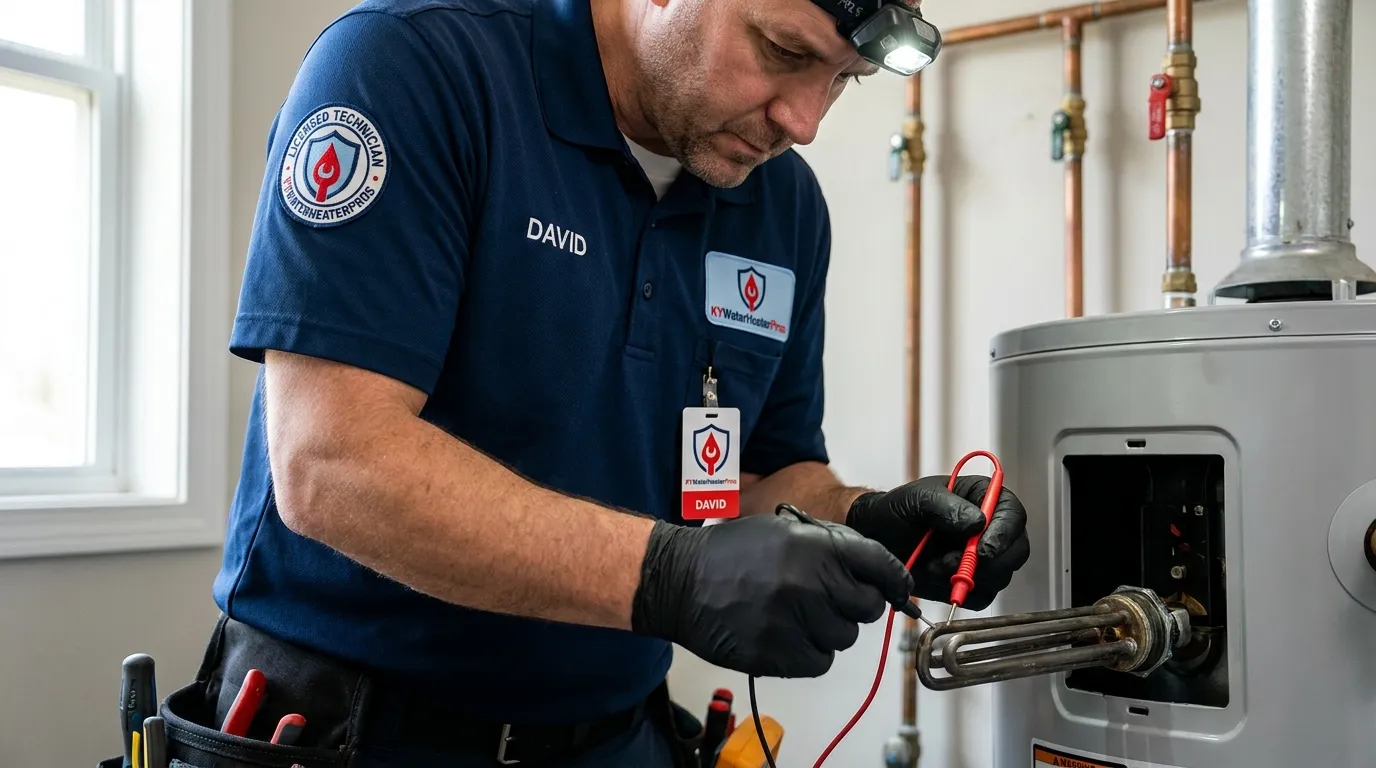
Licensed technicians start with symptom observation and testing, not part replacement guessing. For no hot water on electric units, voltage testing at the thermostat and heating elements identifies whether you have a power supply failure (tripped breaker, blown fuse), thermostat failure (no continuity), or element failure (infinite resistance). For gas units, pilot observation and thermocouple millivolt testing determine whether the problem is safety sensor failure or gas valve failure. Sediment inspection requires draining water through the drain valve and checking for debris—if you see chunks of lime scale or rust, the tank has internal corrosion that repair can't address.
Legitimate contractors provide written diagnostic findings before proposing repairs. You should receive: symptoms verified, components tested, test results (voltage, continuity, millivolt readings), estimated repair cost, estimated replacement cost, and honest guidance on repair lifespan given the unit's age and water conditions. Beware contractors who quote repairs without testing or who push replacement without showing you diagnostic evidence—but also recognize that an experienced technician can identify non-repairable tank corrosion visually (rust stains, weeping around seams, flaking exterior) without disassembling components.
For Lexington homeowners, the repair decision should factor in how long you plan to stay in the home. If you're selling within 2 years, a $250 thermostat repair makes sense even on a 10-year-old tank—it buys enough time to disclose the age honestly without facing pre-sale failure. If you're staying 5+ years, replacement now at your timing beats emergency replacement during January cold snaps when units fail under maximum demand.
Call +1-888-387-1216 for diagnostic service and honest repair-vs-replace guidance based on your water heater's age, condition, and your household timeline.
Should You Repair or Replace Your Lexington Water Heater?
Answer 6 quick questions for a data-driven recommendation based on your unit's condition and Lexington water quality.
Question 1 of 6 — Age Factor (35% weight)
How old is your water heater?
Water Heater Repair in Lexington
Most water heater problems can be diagnosed and repaired in a single visit. Here's what we see most often — and when it's smarter to replace instead of repair.
No Hot Water
Most common call. Usually caused by a failed thermocouple, heating element, or gas valve. Same-day repair in most cases.
Typical Cost: $150–$400
Leaking Tank
If the leak is from the T&P valve or a fitting, it's repairable. If the tank itself is corroded and leaking from the bottom, replacement is the only option.
Repair: $150–$350 | Replace: $1,200+
Inconsistent Temperature
Often a faulty thermostat or dip tube. Electric heaters may have a failed upper or lower element causing lukewarm water.
Typical Cost: $150–$350
Rumbling or Popping
Sediment buildup causing water to boil beneath the layer. A flush may fix it — but heavy buildup in old tanks often means replacement time.
Flush: $100–$200 | Replace if severe
Pilot Won't Stay Lit
Usually a thermocouple or pilot assembly issue. Quick repair — but if you smell gas, evacuate and call 911 first.
Typical Cost: $150–$250
Rusty or Smelly Water
Depleted anode rod allows tank corrosion. An anode rod replacement can extend tank life 3–5 years — if the tank hasn't started leaking yet.
Anode Rod: $150–$300
Repair vs. Replace: The Decision Framework
buildRepair Makes Sense When:
- The water heater is less than 8 years old
- The repair cost is under 50% of replacement
- The tank itself isn't leaking
- It's a single component failure (element, valve, thermocouple)
swap_horizReplace Makes Sense When:
- The unit is 10+ years old
- Tank is leaking from the body
- Multiple repairs in the past 12 months
- Repair cost exceeds 50% of a new unit
Most water heater repairs in Lexington can be diagnosed and completed in a single visit. Whether it's a failed thermocouple, leaking T&P valve, or sediment buildup from Fayette County'slocal water conditions, our Master Plumber-licensed technicians carry common parts on every truck. Same-day repair service is available — call +1-888-387-1216.
Lexington Water Heater Cost Estimator
Get a personalized cost range based on your situation — no email required, no sales pitch.
Step 1 of 5
What service do you need?
Lexington Water Heater Hiring Checklist
Select your situation and get a customized, screenshot-ready checklist for vetting contractors in Lexington.
What type of service do you need?
Why Lexington Homeowners Choose Us
We're not just another plumbing company. Every job is backed by Master Plumber licensing, manufacturer warranties, and a commitment to doing the work right the first time.
KY Master Plumber Licensed
Every contractor carries a Kentucky Master Plumber license — not just a general plumbing cert. Trained specifically on water heater code compliance, gas line safety, and local regulations.
True 24/7 Emergency Response
Midnight burst tank? Gas leak at 5 AM? We don't use an answering service — a licensed plumber responds to emergency calls within 30 minutes of your call, day or night.
Transparent, Written Quotes
No surprises. Every job starts with a written diagnostic + quote before any work begins. If the price changes, you approve it first — zero hidden fees, zero pressure.
Full Warranty Coverage
Every installation includes the manufacturer's full warranty plus our 1-year labor guarantee. If something goes wrong within a year of our work, we fix it — free.
Code-Compliant Installation
We pull all required permits and schedule inspections. Your installation meets current Kentucky building code — including expansion tanks, TPRV discharge, and proper venting.
Energy Efficient Options
We help you right-size your water heater and choose Energy Star certified models that qualify for Kentucky utility rebates — saving you money every month for years.
How It Works
From your first call to the final inspection, here's exactly what to expect.
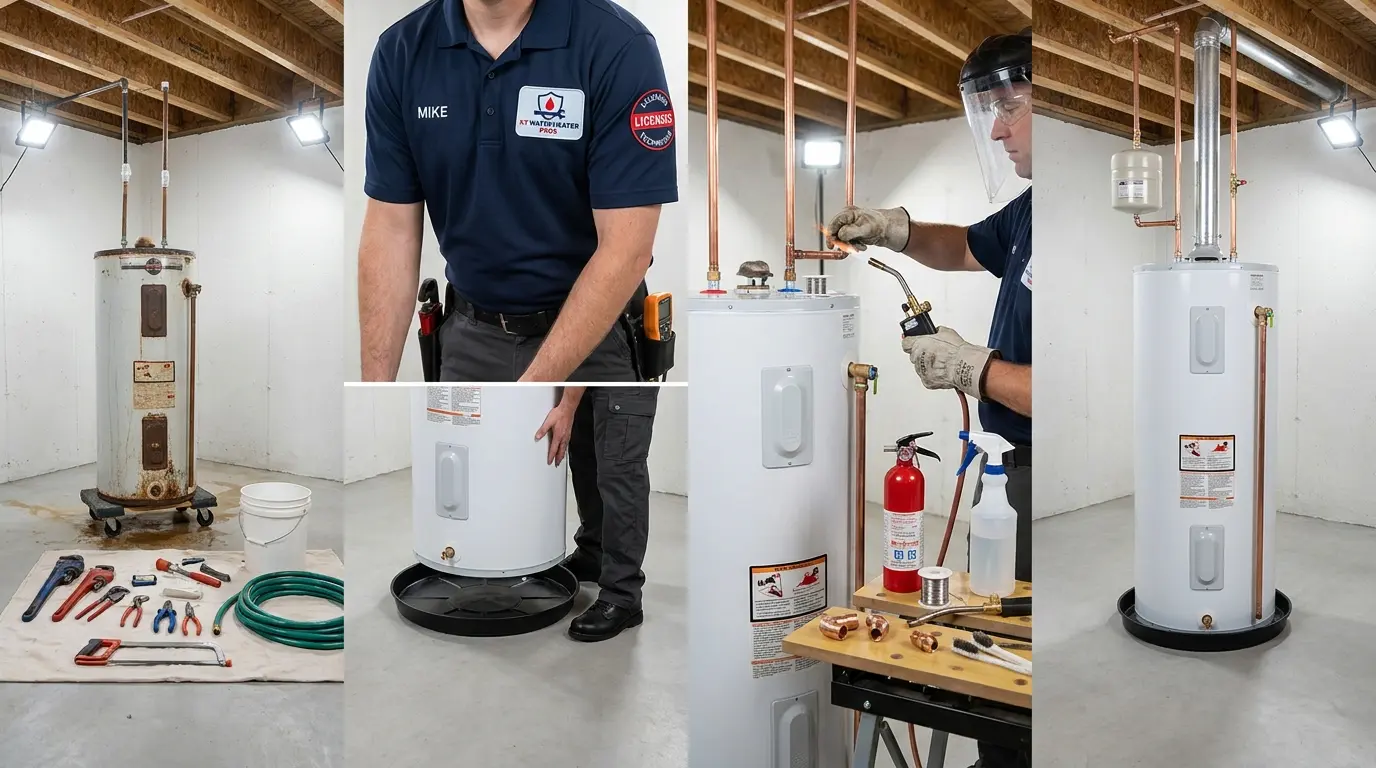
Call & Describe
Call +1-888-387-1216 and describe your water heater issue. We'll ask a few targeted questions to prioritize your call — emergency or scheduled.
On-Site Diagnosis
A licensed plumber arrives, inspects your water heater, and gives you a written diagnosis with all options and costs — before any work starts.
Approve & Execute
You choose the option that fits your budget. We handle permits, parts sourcing, old unit disposal, and the work itself — all in one visit when possible.
Inspect & Warranty
We test the system, walk you through operation, and provide warranty documentation. For installations, we schedule the city inspection for you.
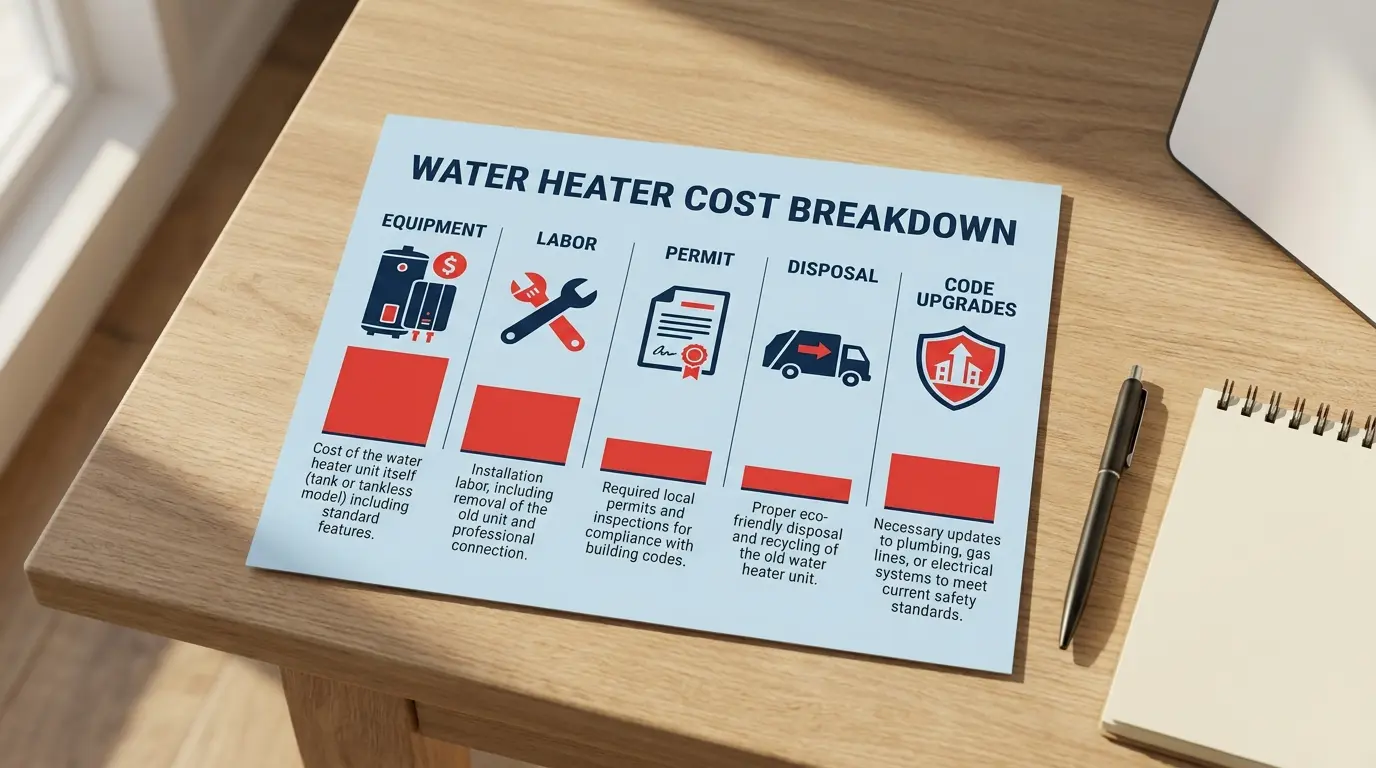
Transparent Pricing for Lexington
No hidden fees. Every job starts with a written quote — here are typical ranges so you know what to expect.
Repair
$150–$600
Typical repair range
- check_circleThermocouple & pilot assembly: $150–$250
- check_circleHeating element: $150–$300
- check_circleGas valve: $250–$450
- check_circleT&P valve: $150–$250
- check_circleAnode rod: $150–$300
Tank Installation
$1,200–$2,500
Installed with permits
- check_circle40-gal gas: $1,200–$1,800
- check_circle50-gal gas: $1,400–$2,000
- check_circleElectric 50-gal: $1,200–$1,800
- check_circleAll permits & disposal included
- check_circleCode compliance upgrades included
Tankless Installation
$3,000–$5,500
Installed with gas line upgrades
- check_circleIndoor gas: $3,000–$4,500
- check_circleOutdoor gas: $2,800–$4,000
- check_circleElectric tankless: $2,500–$3,500
- check_circleGas line sizing included
- check_circleRecirculation pump available
infoKentucky Utility Rebates: Many Lexington utility companies offer $200–$750 rebates on high-efficiency and ENERGY STAR water heaters. We'll help you identify and apply for every rebate you qualify for.
Lexington water heater pricing varies based on unit type, installation complexity, and whether your Fayette County home requires code upgrades. We provide transparent, written quotesbefore starting any work — no hidden fees, no pressure. Many Kentucky utility companies offer $200–$750 in rebates on high-efficiency models, and we'll help you apply. Call +1-888-387-1216 for your personalized quote.
Nearby Cities We Serve
We also serve these communities near Lexington — all within 20 miles.
Maysville
Mason Co.
Covington
Kenton Co.
Grayson
Carter Co.
Franklin
Simpson Co.
Alexandria
Campbell Co.
Ashland
Boyd Co.
Barbourville
Knox Co.
Cumberland
Harlan Co.
Corbin
Whitley Co.
Whitesburg
Letcher Co.
Danville
Boyle Co.
Hazard
Perry Co.
Somerset
Pulaski Co.
Hartford
Ohio Co.
Tompkinsville
Monroe Co.
Find Water Heater Service in Your Kentucky City
We connect homeowners across all 120 Kentucky counties with licensed Master Plumber contractors. Search for your city or browse below.
Louisville
Jefferson County
Pop: 1,022,630
Lexington
Fayette County
Pop: 321,354
Bowling Green
Warren County
Pop: 98,537
Elizabethtown
Hardin County
Pop: 78,446
Owensboro
Daviess County
Pop: 73,115
Covington
Kenton County
Pop: 40,930
Georgetown
Scott County
Pop: 36,281
Richmond
Madison County
Pop: 34,662
Florence
Boone County
Pop: 31,699
Nicholasville
Jessamine County
Pop: 31,066
Hopkinsville
Christian County
Pop: 30,771
Jeffersontown
Jefferson County
Pop: 28,800
Frankfort
Franklin County
Pop: 28,479
Independence
Kenton County
Pop: 28,256
Henderson
Henderson County
Pop: 28,201
Paducah
McCracken County
Pop: 26,248
Radcliff
Hardin County
Pop: 22,839
Ashland
Boyd County
Pop: 21,695
Madisonville
Hopkins County
Pop: 19,533
Erlanger
Kenton County
Pop: 19,506
Frequently Asked Questions
Honest answers to the questions Lexington homeowners ask most.
How much does a water heater replacement cost in Lexington?
expand_more
How long does a water heater installation take?
expand_more
Should I repair or replace my water heater?
expand_more
Do you offer tankless water heater installation?
expand_more
Do I need a permit for a water heater in Lexington?
expand_more
What brands do you install?
expand_more
Is your emergency service really 24/7?
expand_more
Ready to Solve Your Lexington Water Heater Problem?
Our licensed contractors respond to Lexington emergency calls within 30 minutes — 24 hours a day, 7 days a week. For planned replacements, get a free written quote today.
verified_userAll contractors verified for Kentucky Master Plumber License and required insurance.